- Electrician pay hub
£19.00/hr median: day rates, price work and take-home figures for electricians.
- Plumber pay hub
£18.00/hr median: rates and take-home for plumbers and heating engineers.
- Carpenter pay hub
£16.98/hr median: carpenters and joiners, day rates, price work and take-home.
- Bricklayer pay hub
£16.47/hr median: brickwork rates, price-per-metre work and take-home.
- Painter and decorator pay hub
£15.70/hr median: decorating day rates and take-home figures.
- CIS deductions explained
The 20% and 30% deductions: what HMRC takes, what is excluded, gross payment status and reclaiming overpayments.
- Take-home pay calculator
Salary or day rate in, monthly take-home out — worked on the 2026/27 UK tax model.
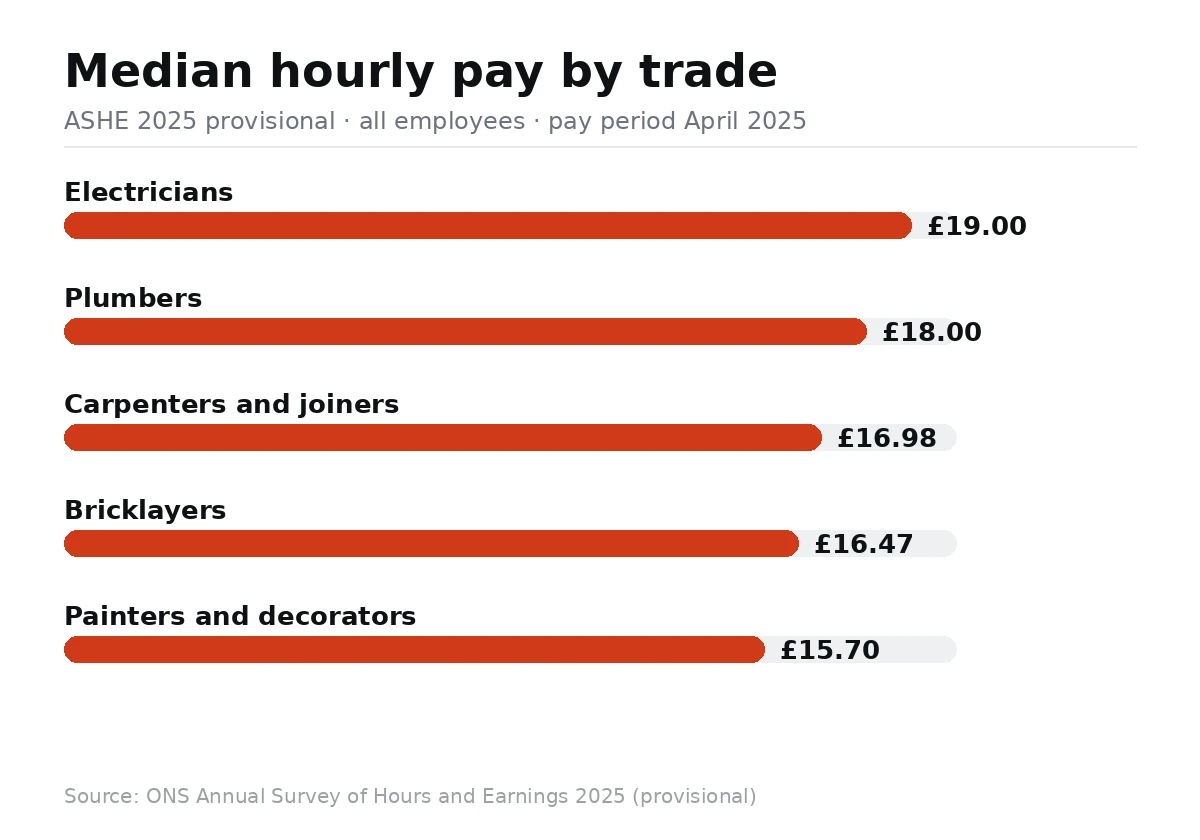
| Median hourly pay | Weekly gross at 40 hrs (derived) | Typical day-rate band (hourly x 8) | |
|---|---|---|---|
| Electricians | £19.00 | £760.00 | £150–£155 |
| Plumbers | £18.00 | £720.00 | £140–£145 |
| Carpenters and joiners | £16.98 | £679.20 | £135–£140 |
| Bricklayers | £16.47 | £658.80 | £130–£135 |
| Painters and decorators | £15.70 | £628.00 | £125–£130 |
Why construction pay is so complicated
CIS deductions come off the top
Before tax, National Insurance, or anything else is calculated, most construction subcontractors lose a slice of every invoice to the Construction Industry Scheme. If you are registered with HMRC for CIS, your contractor deducts 20% from the labour portion of what you are paid; if you are not registered, or HMRC cannot verify you, the deduction is 30%. The money is not a fee and it is not lost — it is an advance payment toward your income tax and National Insurance bill — but it comes out of your cash flow months before your final tax bill is due.
Two things make CIS deductions bite. First, they come off gross income at a flat 20%, which is usually more than your eventual effective tax rate — so you are effectively lending HMRC money interest-free until Self Assessment reconciles it. Second, they apply to the labour element only: materials you paid for directly, plant hire and VAT are excluded, provided you can evidence them. Subcontractors who cannot prove their materials costs pay 20% on the full invoice — one of the most expensive paperwork failures in construction.
The scheme catches a huge share of the workforce: anyone doing construction work as a subcontractor for a contractor, including firms that act as both. Employees sit outside CIS entirely — their employer deducts tax through PAYE instead. Which side of that line you are on decides everything about how you are paid, and the CIS deductions guide walks through the rates, registration, gross payment status, and how to reclaim overpaid deductions.
Day rates, price work and salaries are three different games
Construction pays in three currencies. The day rate — around £150 to £155 for electricians, £125 to £130 for painters and decorators at current medians — is what agencies and contractors quote most often. It is simple: one day's labour, one price, usually for an eight-hour day on site. Multiply by five for the weekly figure, but do not multiply by 52 for the year — nobody works 52 weeks, and nobody should budget as though they do.
Price work is the second currency: a fixed price for a job — £1,200 to hang and finish a set of doors, say, or a per-metre rate for brickwork. Skilled, fast tradespeople can out-earn day rates substantially on price, which is why experienced bricklayers and carpenters chase it. The risk runs the other way too: a job that runs long, a snagging list, or materials arriving late turns a good price into a bad week. Price work rewards speed and punishes optimism.
The third currency is the salary: site managers, employed maintenance electricians, and facilities roles paid monthly through PAYE. Salaries look lower than day-rate equivalents — a £40,000 salary works out at roughly £154 a day before holidays — but they include paid leave, sick pay, and pension contributions that day-rate workers fund themselves. Comparing a salary with a day rate without pricing the missing benefits is the most common mistake in construction pay decisions.
Self-employed, umbrella, or employed: the setup decides the number
Three working arrangements dominate UK sites, and the same trade can be paid three different ways depending on which one applies. Employed staff are paid through PAYE with tax and National Insurance deducted by the employer, plus auto-enrolment pension and statutory sick and holiday pay. The headline figure is the lowest of the three, and the take-home is the most predictable.
Genuinely self-employed subcontractors invoice contractors, suffer CIS deductions at 20% (or 30% if unregistered), and settle the final bill through Self Assessment — claiming expenses, and often receiving a rebate because the flat 20% deduction exceeded their actual liability. They set their own rates and keep the most of each pound earned, but they carry the risk: no work means no pay, no holiday pay, and no safety net.
Umbrella companies sit between the two: the worker is employed by the umbrella, which invoices the agency or end client, deducts PAYE tax, employee National Insurance, and its own margin and employment costs, then pays a net wage. The advertised umbrella rate looks close to a self-employed day rate, but the deductions — including employer National Insurance and the apprenticeship levy, passed through the margin — mean the take-home lands closer to employed pay. Anyone choosing between an umbrella offer and a CIS subcontracting role should run both through the take-home calculator with honest figures rather than trusting the headline rate.
Weather, gaps and the feast-or-famine year
Construction is seasonal and cyclical in a way office work is not. Bricklayers lose days to frost and heavy rain; groundworkers lose weeks to waterlogged sites; almost every trade loses the fortnight around Christmas and the odd week when one project finishes before the next one starts. A day rate of £150 sounds like £39,000 a year until you subtract the weeks that never happened — which is why most self-employed tradespeople plan on 44 to 46 working weeks, not 52.
The gaps are not just weather. Between contracts there is dead time: chasing the next job, pricing work, waiting on a start date that slips. Employed staff are insulated from this — the salary arrives regardless. For subcontractors, the answer is pricing the risk into the rate: a day rate that looks generous against a salary usually stops looking generous once you cost four unpaid weeks and your own pension contributions.
There is a counterweight. When demand runs hot — and it has for most of the last decade in the South East and on infrastructure work — rates move fast. Tradespeople willing to travel, work weekends, or take short-notice starts can command premiums of 10% to 20% above the medians on this page. The medians are the middle of the market; the edges move with demand.
Where the five trades sit
Electricians top the five-trade table at £19.00 an hour — a premium that reflects the qualification barrier. You cannot legally do most electrical installation work without the right tickets, and the supply of qualified electricians is constrained in a way general labour is not. Plumbers sit just behind at £18.00, with gas-safe registered engineers commanding more.
Carpenters and joiners at £16.98 and bricklayers at £16.47 occupy the middle: highly skilled trades where price work lets the fastest earners pull well clear of the median. Painters and decorators at £15.70 anchor the table — still comfortably above the national median hourly wage, but the lowest barrier to entry of the five keeps a lid on rates.
The day-rate bands derived from these medians — roughly £150–155 for electricians, £140–145 for plumbers, £135–140 for carpenters, £130–135 for bricklayers, £125–130 for painters — are the rates the middle of the market actually sees. Each trade's hub page breaks its band down further: who pays at the top of it, who pays at the bottom, and what the take-home looks like after CIS or PAYE.
About these figures
How the medians were compiled
The hourly medians on this page come from the Office for National Statistics' Annual Survey of Hours and Earnings (ASHE) 2025 provisional release, pay period April 2025, all employees. The five occupations follow Standard Occupational Classification 2020 codes: electricians (SOC 5241), plumbers and heating and ventilating engineers (SOC 5314), carpenters and joiners (SOC 5315), bricklayers (SOC 5312), and painters and decorators (SOC 5323). Day-rate bands are derived as eight times the hourly median and rounded to the nearest £5; weekly figures are forty times the hourly median.
A note on what 'all employees' means: ASHE covers employees on payrolls, and the medians blend site-based staff with those on maintenance and facilities contracts. Genuinely self-employed subcontractors paid through CIS are not in the ASHE sample — their earnings are captured in no official survey, which is why day-rate evidence on this page is presented as a band, not a single figure.
How to use this hub
Start with your trade: each of the five hub pages linked below carries the rate detail, day-rate bands, and take-home workings for that trade. If you are a subcontractor and CIS deductions are new to you, read the CIS deductions guide before anything else — the 20% deduction changes every comparison on this page. Everyone else can go straight to the take-home calculator with a salary or day rate and see the monthly figure.
Construction pay FAQs
How much do construction workers earn per hour in the UK?
The ONS Annual Survey of Hours and Earnings (2025 provisional, pay period April 2025) puts median hourly pay at £19.00 for electricians, £18.00 for plumbers, £16.98 for carpenters and joiners, £16.47 for bricklayers, and £15.70 for painters and decorators. Those are all-employee medians blending employed and payroll staff. Self-employed subcontractors on day rates typically earn more per hour than the medians suggest — the derived day-rate bands run £150–155 for electricians down to £125–130 for painters — but they also work fewer paid weeks and fund their own holidays, sick cover and pensions.
What is the CIS deduction and how does it work?
The Construction Industry Scheme requires contractors to deduct tax from subcontractors' pay before it reaches them: 20% for subcontractors registered with HMRC, 30% for those who are not registered or cannot be verified. The deduction applies to the labour portion of the invoice — VAT, materials the subcontractor paid for directly, plant hire and fuel (except travel fuel) are excluded. It is not an extra tax but an advance payment toward the subcontractor's income tax and National Insurance, reconciled through Self Assessment — and because the flat 20% usually exceeds the real liability, most subcontractors receive a rebate each year. Subcontractors with gross payment status are paid in full with 0% deducted. The full rules are in the CIS deductions guide.
What is a good day rate for a construction subcontractor in 2026?
A rate at or above the middle-market bands derived from ONS medians is a fair benchmark: £150–155 for electricians, £140–145 for plumbers, £135–140 for carpenters, £130–135 for bricklayers, £125–130 for painters and decorators. London and the South East pay 10–20% above these bands, and short-notice or weekend work commands a premium anywhere. But a day rate is not a salary: multiply by five for the week, then by 44–46 working weeks — not 52 — for the year, and subtract your own pension contributions, insurance and unpaid holidays before comparing it with an employed offer.
Am I better off on CIS as a subcontractor or through an umbrella company?
On take-home alone, CIS as a sole-trader subcontractor usually wins: you invoice the full rate, suffer 20% CIS on the labour element, claim your expenses through Self Assessment, and often receive a rebate. Umbrella work is simpler — the umbrella runs PAYE and you get a net wage with none of the admin — but its margin absorbs employer National Insurance and the apprenticeship levy, so the take-home lands closer to employed pay for the same headline rate. The honest answer depends on your appetite for admin and risk: run both offers through the take-home calculator with realistic hours and expenses, and compare the monthly net, not the day rate.
Do tradespeople earn more on price work than on day rates?
Often yes — when the job goes to plan. Price work pays a fixed sum for a finished job rather than for time on site, so a fast, skilled tradesperson can earn well above the day-rate equivalent: experienced bricklayers and carpenters actively seek it out for exactly this reason. The risk is that a job which runs long, gets snagged, or waits on materials pays the same fixed sum for many more hours, dragging the effective rate below a day rate. Price work also demands pricing skill and a cash buffer, because payment usually follows completion. The ONS medians do not capture price-work earnings separately, so treat the day-rate bands on this page as the floor that price work should beat.
Get pay-rise alerts by email
Pay scales move every April. We email once when the numbers change — no spam, no selling your address, unsubscribe any time.
Double opt-in: you will get a confirmation email before anything is sent.
Sources
- ONS — Annual Survey of Hours and Earnings (ASHE) 2025 provisional. Table 14.1a/14.6a SOC 2020 medians, pay period April 2025, all employees: electricians £19.00/hr, plumbers £18.00/hr, carpenters and joiners £16.98/hr, bricklayers £16.47/hr, painters and decorators £15.70/hr. Accessed 23 September 2026.
- GOV.UK — What you must do as a CIS subcontractor. CIS deduction rates (20% registered, 30% unregistered or unverifiable, 0% gross payment status), costs excluded from deductions, free registration, and reclaiming overpaid CIS through Self Assessment. Accessed 23 September 2026.
- GOV.UK — What you must do as a CIS contractor. Contractor duties: verifying subcontractors with HMRC, deducting at the correct rate, and issuing payment and deduction statements within 14 days of the end of each tax month. Accessed 23 September 2026.
These are estimates for guidance only, not financial advice. Figures are taken from the sources listed above and were correct when this page was reviewed. Your actual pay depends on your contract, hours and tax code — check your payslip and HMRC guidance if anything looks off.