CIS deduction on a £4,000 invoice with £800 of directly-paid materials
| Invoice total | £4,000 |
| Less materials paid for directly (evidenced) | −£800 |
| Amount the CIS deduction applies to | £3,200 |
| CIS deduction at 20% (registered subcontractor) | £640 |
| Paid to the subcontractor | £3,360 |
The complete guide to CIS deductions
What CIS is and who it catches
CIS — the Construction Industry Scheme — is HMRC's set of rules for how payments flow between contractors and subcontractors in construction. It covers most construction work done in the UK: building, alterations, repairs, demolition, and the trades that go with them. If you do construction work for a contractor and you are not their employee, CIS almost certainly applies to you.
The two roles are defined by the work, not the job title. A contractor is the business paying for construction work — typically a main contractor or a firm passing work down the chain. A subcontractor is the business doing the work: that can be a sole trader, a partnership, or a limited company. The same firm can be both at once — a groundworks company hired by a main contractor is a subcontractor, while the bricklayers it brings in make it a contractor too — and it must handle CIS duties in both directions.
Registration is free, and it is the subcontractor's job to register before work starts. Employees do not register at all — if you are employed, your employer handles tax through PAYE and CIS has nothing to do with you. If you are unsure which side of the line you fall on, HMRC's employment status guidance is the place to check, because getting it wrong means operating under the wrong tax rules entirely.
The three deduction rates
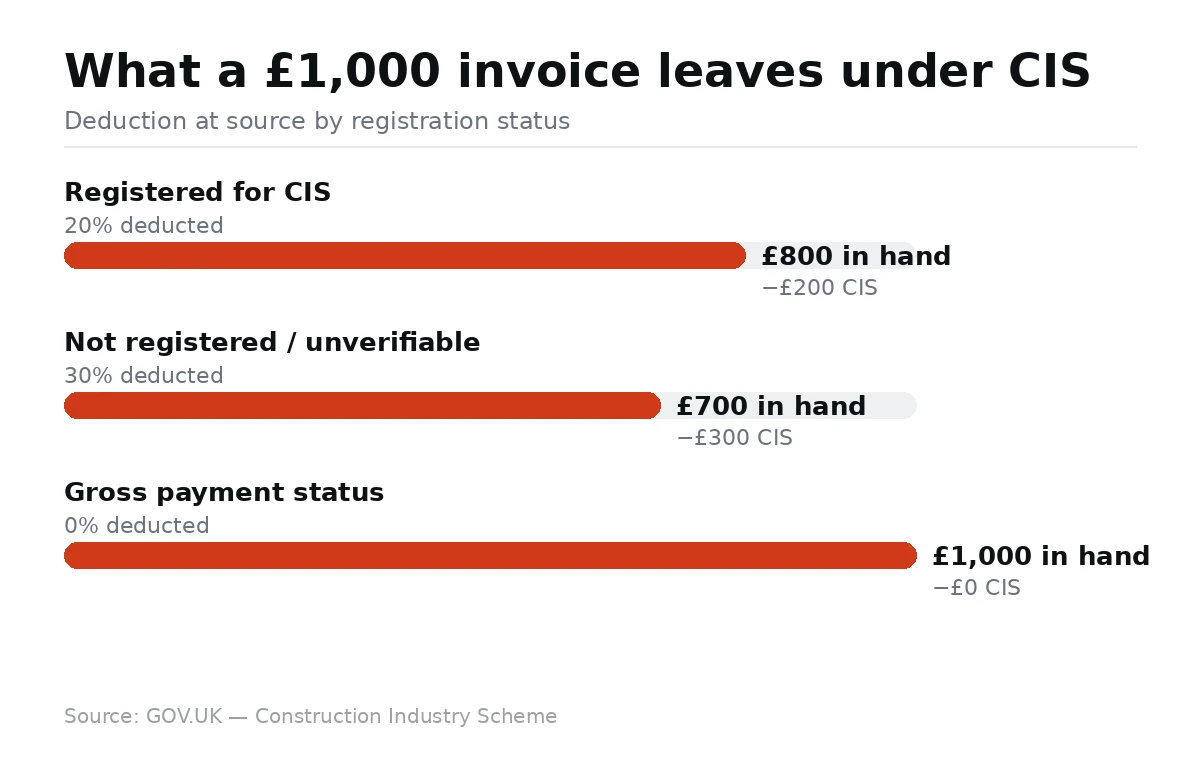
There are three rates, and which one applies to you is the single most expensive detail in the scheme. Registered subcontractors have 20% deducted from the labour portion of their payments. Subcontractors who are not registered — or who HMRC cannot verify — have 30% deducted. Subcontractors with gross payment status have 0% deducted and are paid in full.
The gap between 20% and 30% is where unregistered subcontractors bleed money. On a £3,200 labour bill, 20% is £640 and 30% is £960 — a £320 difference on a single invoice, repeated every invoice, all year. Registration costs nothing and takes a short application to HMRC, so there is no reason to sit in the 30% band beyond your first days on site.
The deductions are advance payments, not a final bill. Every pound deducted is credited against your income tax and National Insurance when you file your Self Assessment return. Because the flat 20% rate is usually higher than a subcontractor's actual effective tax rate — especially after expenses and the personal allowance — most subcontractors find HMRC owes them money at year end. That is the rebate the industry talks about, and it is real: it is simply your own overpaid tax coming back.
Registering and verification
Registering as a CIS subcontractor is free and done directly with HMRC — online or by phone — before you start work. You will need your National Insurance number, your Unique Taxpayer Reference if you have one, and your business details. Once registered, your contractor verifies you with HMRC before your first payment; verification confirms your registration and tells the contractor which deduction rate to apply.
Verification is the contractor's legal duty, not a courtesy. Before paying a new subcontractor, the contractor must check with HMRC that the subcontractor is registered and get the correct rate. If HMRC cannot verify you — because you never registered, or your details do not match — the contractor must deduct 30%. Contractors who skip verification face penalties, which is why reputable firms will not pay you at 20% on trust while you sort it out.
Registration also puts you on HMRC's radar for Self Assessment, which is where the scheme reconciles. As a registered subcontractor you will need to file a tax return each year declaring your income, your expenses, and the CIS deductions suffered — the totals on your payment and deduction statements. File it, and the overpaid deductions come back as a rebate; ignore it, and you leave your own money with HMRC while risking penalties for the unfiled return.
What the deduction is calculated on — and what is excluded
The deduction applies to the labour element of your invoice, not the whole thing. Several costs must be excluded before the percentage is applied: VAT, materials you paid for directly, plant hire, fuel (except travel fuel), consumable stores, and the cost of manufacturing or prefabricating materials. If your invoice breaks these out clearly, the contractor deducts only from what is left.
Materials are the big one. A subcontractor who supplies £800 of timber, fixings and consumables on a £4,000 invoice should suffer CIS on £3,200 — a £640 deduction at 20%. A subcontractor who cannot evidence the materials, or whose invoice lumps everything together as labour, suffers 20% on the full £4,000 — £800. That £160 difference is pure paperwork: itemised invoices and kept receipts are worth real money under CIS.
The evidence standard matters because contractors are not obliged to take your word for it. Keep supplier invoices and receipts for every material cost you want excluded, and show materials as a separate line on your own invoices. If HMRC ever queries the split, the receipts are your defence — without them, the whole invoice can be treated as labour.
Payment and deduction statements
Every contractor must give each subcontractor a payment and deduction statement within 14 days of the end of each tax month. The statement shows what you were paid and how much CIS was deducted — it is your proof of the advance tax payments you have made, and you will need the totals when you file your Self Assessment return.
Keep every statement. They are the paper trail that turns deducted money into a rebate: your tax return declares total CIS suffered, HMRC matches it against what contractors reported, and the difference between deductions and your actual liability comes back to you. Missing statements mean missing evidence, and while HMRC can often verify from contractor returns, the process is slower and the numbers harder to dispute without your own copies.
If a contractor fails to provide statements, chase them — it is their legal obligation, not a favour. Persistent failure is worth reporting to HMRC: a contractor who will not issue statements may also not be paying the deductions over, which creates problems for your rebate and for them.
Gross payment status
Gross payment status is the 0% band: HMRC agrees to let your contractors pay you in full, with no deductions, because your tax compliance record shows you can be trusted to settle the bill yourself. For established subcontractors with clean records, it is the single best cash-flow improvement CIS offers — the 20% stays in your account through the year instead of sitting with HMRC until your rebate.
You apply to HMRC, and approval depends on passing three tests: a turnover test (your construction turnover over a qualifying period must clear HMRC's threshold), a compliance test (tax returns filed and paid on time, no serious compliance failures), and a business test (you are genuinely running a construction business, with a business bank account and proper records). Fail any of the three and the application is refused — though you can reapply once the shortfall is put right.
Gross payment status is not a holiday from tax. You still owe income tax and National Insurance on everything you earn; the difference is that you pay it through Self Assessment and payments on account rather than having it deducted at source. Subcontractors who win gross payment status and then spend the 20% instead of saving for the January bill discover this the hard way. It rewards discipline and punishes the lack of it.
Reclaiming overpaid CIS through Self Assessment
For sole-trader subcontractors, overpaid CIS comes back through the annual Self Assessment return. You declare your total turnover, subtract your allowable expenses — materials, travel, tools, insurance, accountancy, a reasonable share of home-office and phone costs — and arrive at your taxable profit. Income tax and National Insurance are calculated on that profit; the CIS deductions suffered are credited against the bill; and if the deductions exceed the bill, HMRC refunds the difference.
The maths favours the subcontractor in most cases. A sole trader with £45,000 of turnover, £12,000 of expenses and £6,600 of CIS deducted (20% of £33,000 labour) owes roughly £4,100 in income tax and Class 4 National Insurance on £33,000 of profit — leaving a rebate of around £2,500. The exact figure depends on the personal allowance, the expense claim and other income, but the pattern holds: the flat 20% deduction rate almost always overshoots the real liability of a subcontractor with normal expenses.
Limited-company subcontractors reclaim differently: CIS deductions suffered are set against the company's PAYE and National Insurance liabilities through the year, with any excess carried forward or refunded. The principle is identical — deductions are advance payments, not a final bill — but the mechanics run through the payroll rather than the director's personal return. Either way, the deductions are never simply lost: unclaimed CIS is the most common way subcontractors hand money to HMRC for nothing.
CIS vs employed vs umbrella vs limited company
Four ways to work on a UK site, four different relationships with tax. Employed: the employer runs PAYE, deducts income tax and employee National Insurance, pays employer National Insurance on top, and provides holiday pay, sick pay and pension contributions. Take-home is the lowest headline figure but the most predictable, and CIS never appears.
CIS subcontractor as a sole trader: you invoice, the contractor deducts 20% (or 30% if you are unregistered), you claim expenses and reconcile through Self Assessment. Usually the highest take-home of the four for the same gross, with the most admin and the least security. This is the default for experienced tradespeople who know their numbers.
Umbrella company: you become the umbrella's employee; it invoices the agency, deducts PAYE, employee National Insurance, and its margin — which also absorbs employer National Insurance and the apprenticeship levy passed down the chain. The advertised rate looks close to a CIS day rate, but the take-home lands nearer employed pay. It suits people who want PAYE simplicity without finding their own contracts.
Limited company: you invoice through your own company, suffer CIS deductions at 20% or 30% (or 0% with gross payment status), and pay yourself through a salary-and-dividends mix. The admin burden is highest — accounts, corporation tax, confirmation statements — and since the off-payroll working rules, many end clients will not engage limited-company contractors for site roles at all. For most site tradespeople, the realistic choice is between CIS as a sole trader and PAYE employment; umbrellas and limited companies are niche answers to specific situations.
Mistakes that cost subcontractors money
Not registering is the most expensive mistake: 30% instead of 20% on every invoice until you fix it. Registration is free, so every week spent unregistered is money thrown away — and contractors cannot legally pay you at 20% on trust while you sort it out.
Poor materials evidence is the second: invoices that lump labour and materials together, receipts thrown away, no separate materials line. Every pound of materials you cannot evidence is a pound treated as labour and taxed at 20% at source. Itemise invoices, keep supplier receipts, and the deduction shrinks to what it should be.
The third is the cash-flow shock: spending the gross invoice as though the 20% deduction were the whole tax bill, then being unable to pay the Self Assessment balance — or, for gross-payment-status holders, the January payment on account. The deduction is an advance, not the total: budget for the final bill, or the expected rebate turns into a debt.
The fourth is ignoring the rebate entirely. Subcontractors who never file, file late, or file without declaring their CIS deductions leave their own overpaid tax with HMRC. The rebate is not a bonus and not luck — it is the arithmetic of a 20% flat deduction against a lower real liability, and claiming it is the whole point of filing accurately.
CIS deductions FAQs
What is CIS in construction?
The Construction Industry Scheme is HMRC's scheme for taxing construction subcontractors. Contractors must deduct tax at source from what they pay subcontractors — 20% for registered subcontractors, 30% for unregistered or unverifiable ones, 0% for those with gross payment status — and pay it straight to HMRC. The deductions are advance payments toward the subcontractor's income tax and National Insurance, reconciled through Self Assessment. Registration is free.
How much is the CIS deduction?
20% of the labour portion of your invoice if you are registered with HMRC for CIS; 30% if you are not registered or HMRC cannot verify you; 0% if you hold gross payment status. The 10-point gap between registered and unregistered is the most expensive detail in the scheme — on a £3,200 labour bill it is the difference between £640 and £960 deducted, every invoice, all year.
Do I need to register for CIS?
Yes, if you work as a subcontractor in construction — registration is free and should be done before you start work, online or by phone with HMRC. Your contractor must verify you before your first payment; without verification they must deduct 30%. Employees do not register at all: if you are employed, tax is handled through PAYE and CIS does not apply. If you are unsure of your employment status, check HMRC's guidance before choosing a working arrangement.
What can be excluded from CIS deductions?
The deduction applies to labour only. Excluded before the percentage is applied: VAT, materials you paid for directly, plant hire, fuel (except travel fuel), consumable stores, and the cost of manufacturing or prefabricating materials. Materials are where most money is saved or lost: you must evidence them with supplier receipts and show them as a separate line on your invoice, or the contractor can treat the whole invoice as labour.
How do I get gross payment status?
Apply to HMRC and pass three tests: a turnover test on your construction turnover over a qualifying period, a compliance test (returns filed and tax paid on time, no serious compliance failures), and a business test (genuine construction business with a business bank account and proper records). Approval means contractors pay you in full with 0% deducted — a major cash-flow improvement — but you still owe the full tax through Self Assessment and payments on account, so it rewards disciplined saving.
How do I claim back overpaid CIS?
Sole traders reclaim through the annual Self Assessment return: declare turnover, subtract allowable expenses, calculate income tax and National Insurance on the profit, and credit the total CIS deducted (shown on your payment and deduction statements) against the bill. Because the flat 20% deduction usually exceeds the real liability, the difference comes back as a rebate — often a few thousand pounds. Limited companies set CIS suffered against PAYE liabilities through the payroll instead. In both cases, unclaimed CIS is simply your own money left with HMRC.
What is a CIS payment and deduction statement?
The document your contractor must give you within 14 days of the end of each tax month, showing what you were paid and how much CIS was deducted. It is your proof of advance tax payments and the evidence you need to claim your rebate through Self Assessment — keep every one. If a contractor will not issue statements, chase them: it is a legal obligation, and persistent failure is worth reporting to HMRC.
Is CIS better than working through an umbrella company?
For take-home pay, CIS as a sole trader usually wins: you invoice the full rate, suffer 20% on the labour element, claim expenses, and typically receive a rebate. Umbrella work is simpler — the umbrella employs you, runs PAYE, and pays a net wage — but its margin absorbs employer National Insurance and the apprenticeship levy, so the take-home lands closer to employed pay. Umbrellas suit people who want PAYE simplicity without the admin; CIS suits tradespeople who know their numbers and want to keep the most of each pound.
Get pay-rise alerts by email
Pay scales move every April. We email once when the numbers change — no spam, no selling your address, unsubscribe any time.
Double opt-in: you will get a confirmation email before anything is sent.
Sources
- GOV.UK — What you must do as a CIS subcontractor. Deduction rates (20% registered, 30% unregistered or unverifiable, 0% gross payment status), costs excluded from deductions (VAT, directly-paid materials, plant hire, fuel, consumable stores, manufacturing), free registration, and reclaiming overpaid CIS through Self Assessment. Accessed 23 September 2026.
- GOV.UK — What you must do as a CIS contractor. Contractor duties: verifying subcontractors with HMRC, deducting at the correct rate, paying deductions to HMRC, and issuing payment and deduction statements within 14 days of the end of each tax month. Accessed 23 September 2026.
These are estimates for guidance only, not financial advice. Figures are taken from the sources listed above and were correct when this page was reviewed. Your actual pay depends on your contract, hours and tax code — check your payslip and HMRC guidance if anything looks off.