Tips, tronc and unsocial hours pay in the UK
The Tips Act: what changed on 1 October 2024
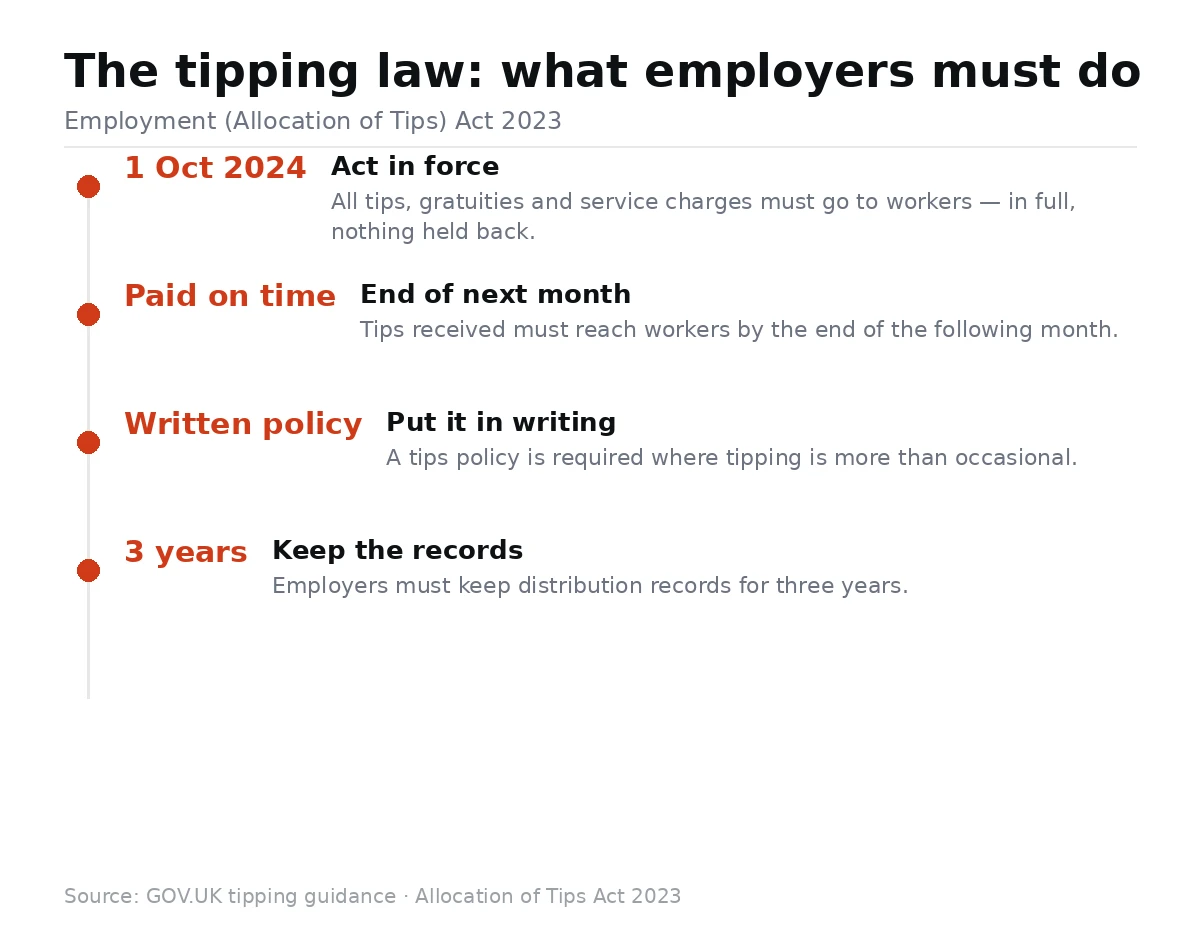
The Employment (Allocation of Tips) Act 2023 came into force on 1 October 2024, and it rewrote the economics of the tip jar. The central rule is blunt: where an employer receives or exercises control or influence over tips, gratuities and service charges, the employer must allocate all of them to workers — in full, with nothing held back. Keeping a percentage of the discretionary service charge as house revenue, the practice that funded more than a few head offices, is now unlawful. So is using tips to make up a shortfall against the minimum wage: tips sit on top of lawful pay, not inside it.
Alongside the Act sits a statutory Code of Practice on the fair and transparent distribution of tips, which employers must have regard to when designing their allocation. The Code's thrust is fairness and transparency rather than a fixed formula: the split between front-of-house and kitchen, between full-timers and part-timers, between grades, must be justifiable and visible. There is no statutory 70/30 or 80/20 rule — the employer sets the policy, but it must be a policy, written down and defensible, not a whim.
The practical consequence for workers is a shift in leverage. Before the Act, asking where the service charge went was a favour; now it is a right backed by statute. Before the Act, an employer that kept 10% of card tips was operating a business model; now it is breaking the law. The money involved is not trivial: in a busy restaurant, the service charge pool can run to thousands of pounds a month, and every pound of it now belongs — by law — to the workers.
The timetable and the paperwork
The Act sets a hard deadline: tips must be paid to workers by the end of the month following the month in which they were received. January's tips must reach workers by the end of February; the employer cannot sit on the pool for a quarter, or use it as working capital, or wait until the annual party to distribute it. Late payment is non-compliance, not administration.
The paperwork duties are just as specific. Employers must have a written policy on the allocation of tips where tips are left more than occasionally — which covers every restaurant, bar, café and hotel where tipping is routine. Workers have the right to request their tipping records: how much was allocated to them, and on what basis. And employers must keep records of how tips were distributed for three years, so the paper trail outlives any individual dispute.
There is one important boundary to the Act's scope: cash tips handed directly to a worker, with no employer involvement — the note pressed into a waiter's hand, the coins left on the table and pocketed — are outside the Act entirely. They belong to the worker who received them, full stop. Income tax still applies to them (HMRC expects workers to declare cash tips), but the allocation rules, the timetable and the record-keeping do not touch them.
Troncs and the tax position
A tronc is the industry's traditional machinery for splitting tips: a separate, organised arrangement — the word comes from the French 'tronc', the collection box — run by a troncmaster who collects the tips and distributes them according to the house rules. Large restaurants and hotel groups have run troncs for decades; the Tips Act now governs what flows through them without abolishing them.
The tax position of a tronc turns on one question: is the troncmaster independent of the employer? Where an independent troncmaster allocates the tips, income tax still applies — tips are earnings, and HMRC takes its share — but employer and employee Class 1 National Insurance do not. That is the statutory position for a genuinely independent tronc, and it is the reason many large operators maintain one: the NI saving is shared, in effect, between the house and the staff.
The qualifier matters. Where the 'troncmaster' is really the employer wearing a different hat — the manager distributing tips at the employer's direction — the arrangement is not independent, and National Insurance applies to the distributions exactly as if they were wages. Typical practice in smaller operations is simpler still: tips paid through payroll are taxed and NI'd like any other pay, with income tax collected through PAYE. Whatever the route, tronc and tip income is taxable earnings — include it in the gross on the take-home calculator, because HMRC certainly includes it in the tax calculation.
Service charges, tips and cover charges: the three lines on the bill
Customers see one bill; the law sees three different kinds of money. A discretionary service charge — typically around 12.5% in restaurants, though the figure is set by the house — is added to the bill but can be removed by the customer. Where the employer exercises control over it, it is a qualifying tip under the Act: it must be allocated to workers in full, on the statutory timetable, under the written policy. The 'discretionary' label is doing real legal work here — it is what makes the charge a tip rather than a price.
A voluntary tip — the extra left on the card machine, the cash on the table — is the same in law: the customer's gift to the staff, covered by the Act wherever the employer touches it. The third line is different. A cover charge — the per-head charge some restaurants levy for bread, water or simply the table — is not a tip at all. The customer cannot direct it to the staff, and in typical practice it is employer revenue: it pays for the bread, not the waiter. The Tips Act does not convert it into tips.
The distinction to carry into any job interview is between the discretionary and the non-discretionary. If the charge can be removed from the bill, it is a tip in the eyes of the Act and it belongs to the workers. If it cannot — a fixed service fee, a cover charge, an 'administrative charge' — it is part of the price, and the staff see it only if the employer chooses. Ask which lines on the menu flow to the tronc and which stay with the house; the answer tells you how the employer's pay model really works.
Unsocial-hours premiums: custom, not law
Here is the fact that surprises most services workers: there is no statutory unsocial-hours premium in the UK. No law requires an employer to pay extra for nights, for weekends, for bank holidays, or for the 6am start. Every penny above the basic rate for unsocial hours is contractual — agreed in the contract or the offer letter, or it does not exist. The National Living Wage is a floor under all hours equally; it does not tilt for the hour of day.
What the market typically does is another matter. Night premiums of £1 to £3 an hour above the day rate are common in security and night-shift hospitality, varying by employer; weekend and bank-holiday enhancements — time and a half is the familiar shape — appear in larger operators' contracts. But these are illustrative market ranges, not entitlements, and they differ sharply between a national contract-cleaning firm and an independent bar. Two workers doing the same unsocial hours for different employers can be on very different effective rates, entirely lawfully.
The practical lesson is to price the premium, not the headline. A security role advertised at £14 an hour for nights, against the £14.00 ONS median for guards, is the median with the premium already inside it — the day-shift equivalent would be lower. A kitchen role at £12.41 with no unsocial premium for midnight finishes is paying the median for the hardest hours. Get the premium structure in writing before accepting: interview optimism about 'enhanced rates' has a habit of evaporating between the handshake and the first payslip.
Night work and split shifts: the legal frame
What the law provides for unsocial hours is a ceiling, not a premium. Under the Working Time Regulations, night workers are limited to an average of 8 hours' work per 24-hour period. The 48-hour average weekly working-time limit applies as well, and the daily and weekly rest entitlements — 11 hours' daily rest, 24 hours' weekly rest — frame the rota from both ends. An employer can roster nights; it cannot roster endless nights.
Split shifts — the defining shape of the hospitality working day — have no special pay law at all. The lunch service and the dinner service, the 6am fitness class and the 7pm one, are simply two shifts with a gap between them, and the gap is usually unpaid: only working time counts toward pay and toward the minimum wage. A day that runs 7am to 10pm can contain eight paid hours and a five-hour unpaid hole, and nothing in statute requires the hole to be filled.
That makes the split-shift interview questions concrete: how long is the gap, is any of it paid, is travel between sites working time, and what does a week of split shifts actually gross? The answers vary by employer more than by sector. And for anyone working permanent nights, the health angle is worth a line: the 8-hour average exists because night work carries documented health costs — the premium, where one is paid, is compensation for a real burden, not a bonus.
Holiday pay for irregular hours: the 12.07% rule
Holiday is where irregular-hours workers were historically short-changed, and the 2024 reforms were written to fix it. For leave years starting on or after 1 April 2024, workers with irregular hours — which describes most of the services cluster — accrue holiday at 12.07% of actual hours worked in each pay period. The figure is not arbitrary: 12.07% is 5.6 weeks (the statutory minimum) expressed as a percentage of the 46.4 working weeks in the year. Work 20 hours in a week, accrue 2.41 hours of holiday; work 18.5, accrue 2.23.
The second half of the reform is rolled-up holiday pay — the old practice of folding holiday pay into the hourly rate instead of paying it when leave is taken. It is permitted again, but only for irregular-hours and part-year workers, and only done properly: the holiday element must be paid with wages each pay period and shown as a separate line on the payslip, so the worker can see it. For regular-hours workers the old system stands — holiday paid when taken, no roll-up.
On the payslip, then, an irregular-hours services worker should expect to see one of two things: either holiday accruing in hours and paid on leave, or a distinct rolled-up holiday line each pay period. What should not appear is nothing — an hourly rate with no holiday element anywhere is not a rolled-up arrangement, it is unpaid leave. The 12.07% figure is the one to check the maths against.
Reading a hospitality payslip
A hospitality payslip has more lines than a standard one, and each line is a question answered. Basic pay is the contracted hours at the contracted rate — check the hours against the rota, not against memory. The tronc or tips line is the distribution under the written policy — check it arrived by the statutory timetable (end of the following month) and that the amount tracks the busy and quiet weeks. Rolled-up holiday, where it applies, should be its own visible line, not buried in the hourly rate.
Then the deductions, which work exactly as elsewhere: income tax through PAYE (tips and tronc distributions included — they are earnings), employee National Insurance (except on distributions from a genuinely independent tronc, where Class 1 NI does not apply), auto-enrolment pension on qualifying earnings, and student loan where the threshold is crossed. Overtime and any unsocial-hours premium sit as their own lines above the deductions.
Three checks close the loop. First, does the tronc line match the written tipping policy you were shown — and if you were never shown one, ask for it; where tips are more than occasional, the employer must have it. Second, does the holiday line reflect 12.07% of the hours actually worked? Third, keep every payslip: with tips, tronc, rolled-up holiday and variable hours in play, the year's P60 is the only document that shows the whole picture, and tipping records can be requested from the employer if the numbers ever stop adding up.
About this guide
Where the legal facts come from
The tipping law is the Employment (Allocation of Tips) Act 2023, in force 1 October 2024, with the statutory Code of Practice on fair and transparent distribution of tips: all tips to workers in full, distribution by the end of the month following receipt, a written tipping policy where tips are more than occasional, workers' right to request tipping records, and three-year record-keeping. Cash tips handed directly to a worker with no employer involvement sit outside the Act. The tronc tax position — income tax applies, employer/employee Class 1 National Insurance does not — is stated for the independent-troncmaster case only; employer-controlled distributions are treated as wages.
The holiday position is the government's holiday pay and entitlement reforms: for leave years starting on or after 1 April 2024, irregular-hours workers accrue 12.07% of actual hours worked per pay period, and rolled-up holiday pay is permitted again for irregular-hours workers only, paid with wages and shown separately on the payslip. Night-work limits are the Working Time Regulations' average of 8 hours per 24-hour period. The £12.21 waiter and £12.41 kitchen-assistant medians are ONS ASHE 2025 provisional (pay period April 2025); the National Living Wage is £12.71 for 21+ from 1 April 2026. Tip averages, tronc shares, night premiums and service-charge percentages are typical market practice, labelled as such, not ONS data.
Reviewed and updated
The legal position on tipping, tronc taxation, unsocial hours, night-work limits, split shifts and holiday accrual, and the worked examples, were last reviewed on 24 September 2026. The take-home calculator turns any combination of rate, hours and tip income into the monthly figure — use it with the numbers from your own offer and your own tronc statements, not the illustrative ones here.
Tips, tronc and unsocial hours pay FAQs
When did the tipping law change, and what does it require?
The Employment (Allocation of Tips) Act 2023 came into force on 1 October 2024. Where an employer receives or exercises control or influence over tips, gratuities and service charges, it must allocate all of them to workers in full — keeping a cut of the service charge is now unlawful. A statutory Code of Practice on fair and transparent distribution sets the fairness standard, and employers must have regard to it when designing their allocation policy.
How quickly must my employer pass on tips?
By the end of the month following the month the tips were received — January's tips must reach workers by the end of February. Employers must also have a written tipping policy where tips are left more than occasionally, workers can request their tipping records, and distribution records must be kept for three years. Cash tips handed directly to a worker with no employer involvement are outside the Act, but income tax still applies to them.
What is a tronc, and do I pay National Insurance on tronc tips?
A tronc is an organised arrangement for collecting and distributing tips, run by a troncmaster. Where the troncmaster is independent of the employer, income tax still applies to the distributions but employer and employee Class 1 National Insurance do not — that independence is the whole of the tax advantage. Where the employer controls the distribution, or tips are paid through payroll, National Insurance applies exactly as if the money were wages. Income tax applies in every case: tips are earnings.
Do cash tips count under the Tips Act?
No — cash tips handed directly to a worker, with no employer involvement, are outside the Employment (Allocation of Tips) Act 2023. They belong to the worker who received them, with no allocation timetable or record-keeping duty. They are still taxable income, and HMRC expects workers to declare them. The moment the employer touches the money — a pooled cash jar the manager distributes, for example — the Act's rules apply.
Is a service charge the same as a tip?
A discretionary service charge — one the customer can remove from the bill, typically around 12.5% in restaurants — is treated as a tip under the Act where the employer exercises control over it: it must go to workers in full. A voluntary tip is the same. A cover charge, the per-head levy some restaurants add for bread or the table, is different: the customer cannot direct it to staff, and in typical practice it is employer revenue, not a tip. If the charge cannot be removed from the bill, it is part of the price.
Is there a legal unsocial-hours or night-shift premium?
No. There is no statutory unsocial-hours premium in the UK — every penny above the basic rate for nights, weekends or bank holidays is contractual, agreed in the contract or it does not exist. Typical market practice runs to night premiums of £1 to £3 an hour above the day rate, varying by employer, but these are illustrative ranges, not entitlements. What the law does set is a ceiling: night work is limited to an average of 8 hours per 24-hour period under the Working Time Regulations.
How does holiday pay work if my hours change every week?
For leave years starting on or after 1 April 2024, irregular-hours workers accrue holiday at 12.07% of actual hours worked in each pay period — 5.6 weeks' statutory minimum expressed as a percentage of working weeks. Rolled-up holiday pay is permitted again for irregular-hours workers only: the holiday element is paid with wages each pay period and must appear as a separate line on the payslip. Check the maths against your actual hours: 20 hours worked should accrue 2.41 hours of holiday.
Are split shifts legal, and is the gap between shifts paid?
Split shifts are legal and there is no special pay law for them — the lunch and dinner services, or the early and evening fitness classes, are simply two shifts with a gap between them. The gap is usually unpaid: only working time counts toward pay and toward the minimum wage. A 7am-to-10pm day can contain eight paid hours and a five-hour unpaid hole. Ask at interview how long the gap is, whether any of it is paid, and what a week of split shifts actually grosses.
Get pay-rise alerts by email
Pay scales move every April. We email once when the numbers change — no spam, no selling your address, unsubscribe any time.
Double opt-in: you will get a confirmation email before anything is sent.
Sources
- GOV.UK — New guidance on tipping (Tips Act). Employment (Allocation of Tips) Act 2023 in force 1 October 2024: employers must pass on ALL tips to workers in full — it is unlawful to hold back service charges; statutory Code of Practice on fair and transparent distribution of tips. Accessed 24 September 2026.
- Legislation.gov.uk — Code of Practice on fair and transparent distribution of tips. The statutory instrument bringing the tipping Code of Practice into force: allocation, payment and transparency requirements for employers. Accessed 24 September 2026.
- GOV.UK — Holiday pay and entitlement reforms from 1 January 2024. For leave years starting on or after 1 April 2024, irregular-hours workers accrue holiday at 12.07% of actual hours worked per pay period; rolled-up holiday pay permitted again for irregular-hours workers only, paid with wages and shown separately on the payslip. Accessed 24 September 2026.
- GOV.UK — Maximum weekly working hours. Working Time Regulations: night work limited to an average of 8 hours per 24-hour period; weekly working-time limits, daily and weekly rest entitlements. Accessed 24 September 2026.
- ONS — Annual Survey of Hours and Earnings 2025 (provisional). SOC 2020 medians, pay period April 2025, all employees: waiters & waitresses (SOC 9264) £12.21/hr, kitchen assistants (SOC 9263) £12.41/hr — the wage figures the tipping and unsocial-hours examples build from; tips are not captured in ASHE. Accessed 24 September 2026.
- GOV.UK — National Minimum Wage and National Living Wage rates. National Living Wage £12.71 an hour for workers aged 21 and over from 1 April 2026 — the floor under the hospitality pay examples. Accessed 24 September 2026.
These are estimates for guidance only, not financial advice. Figures are taken from the sources listed above and were correct when this page was reviewed. Your actual pay depends on your contract, hours and tax code — check your payslip and HMRC guidance if anything looks off.