- Bus and coach driver pay hub
£16.21/hr median: PCV licensing, overtime, rest-day working and take-home for bus and coach drivers.
- Security guard pay hub
£14.00/hr median: night premiums, overtime, SIA licence costs and take-home for security guards.
- Cleaner pay hub
£12.63/hr median: multiple employers, unsocial hours, holiday accrual and take-home for cleaners.
- Kitchen assistant pay hub
£12.41/hr median: split shifts, tronc pay, overtime and take-home for kitchen assistants.
- Waiter pay hub
£12.21/hr median: tips, tronc, service charges and take-home for waiters and waitresses.
- Hairdresser and barber pay hub
£12.30/hr median: commission, column pay, chair rental vs employed and take-home.
- Fitness instructor pay hub
£13.85/hr median: class pay, freelance vs employed, split shifts and take-home for fitness instructors.
- Tips, tronc and unsocial hours pay explained
The tipping law, tronc tax, service charges, unsocial-hour premiums, night limits, split shifts and holiday accrual.
| Median hourly pay | Median weekly pay | Implied weekly hours (weekly ÷ hourly) | |
|---|---|---|---|
| Bus & coach drivers (SOC 8212) | £16.21 | £684.10 | ~42.2 hours |
| Security guards (SOC 9231) | £14.00 | £608.00 | ~43.4 hours |
| Fitness instructors (SOC 3433) | £13.85 | £226.80 | ~16.4 hours |
| Cleaners & domestics (SOC 9223) | £12.63 | £233.90 | ~18.5 hours |
| Kitchen assistants (SOC 9263) | £12.41 | £239.00 | ~19.3 hours |
| Hairdressers & barbers (SOC 6221) | £12.30 | £291.50 | ~23.7 hours |
| Waiters & waitresses (SOC 9264) | £12.21 | £194.10 | ~15.9 hours |
Why services pay is so hard to read
The weekly figures are the trap; the hourly figures are the truth
Read quickly, the table above looks like a wage ranking: bus drivers on £684.10 a week at the top, waiters on £194.10 at the bottom. Read properly, it is mostly a ranking of hours. A cleaner on £233.90 a week is not on a £233.90 wage — the cleaner is on £12.63 an hour for about 18.5 hours. A waiter on £194.10 a week is on £12.21 an hour for about 15.9 hours. The weekly medians blend full-time staff with part-timers, and in occupations where part-time work dominates, the weekly figure describes a working pattern more than a pay rate.
This is why the hourly column is the only one that compares. Put a waiter (£12.21) next to a cleaner (£12.63) and they are 42p an hour apart — essentially the same pay. Their weekly medians are £39.80 apart, which looks like a chasm until you see it is hours, not wages: 15.9 against 18.5. Anyone comparing two job offers in services should do the same conversion the table does — weekly offer divided by hourly rate, equals the implied week — and then ask whether the implied hours are the ones they want.
The two roles at the top of the table show the arithmetic working in reverse. Bus drivers at £684.10 a week and security guards at £608.00 are not part-time: their implied weeks of 42.2 and 43.4 hours are long full-time weeks swollen by overtime, unsocial hours and, for drivers, rest-day working. Their weekly medians flatter the basic rate the same way the hospitality medians understate it. In both directions, the hourly figure is the truth and the weekly figure is the truth times the rota.
Ranking the seven roles by the only number that compares
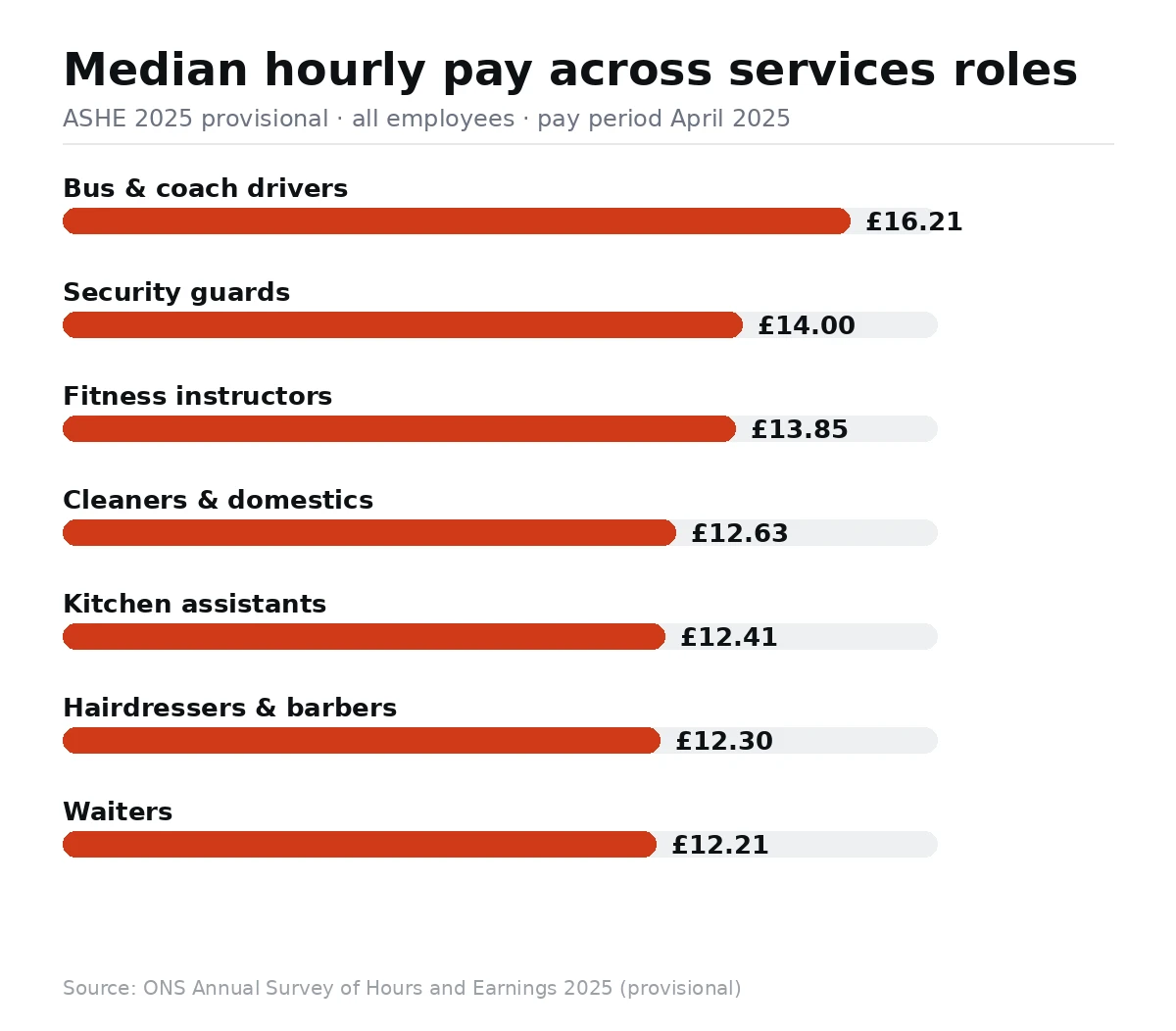
Ranked by median hourly pay, the cluster has a clear shape: bus and coach drivers at £16.21, then a step down to security guards at £14.00, then fitness instructors at £13.85, then the tight hospitality band — cleaners £12.63, kitchen assistants £12.41, hairdressers and barbers £12.30, waiters £12.21 — with just 42p separating all four. Top to bottom, the spread is £4.00 an hour: about £7,800 a year on a 37.5-hour week.
The bus-driver premium is the price of the barrier to entry. A PCV licence costs serious money and weeks of training to obtain, the Driver CPC demands 35 hours of periodic training every five years, and the driver carries legal responsibility for fifty passengers rather than a vanload of parcels. Security sits second for a related reason: the SIA licence, the unsocial hours (a large share of guarding is nights), and the responsibility for premises and people. Employers are not paying for the hours; they are paying for the licence, the vetting and the scarcity.
The hospitality band at the bottom reflects the opposite economics: low barriers to entry, abundant labour supply, and young workforces. Kitchen assistants, hairdressers and waiters sit within 20p of each other because the market treats them as close substitutes at the margin — and because all three draw heavily on workers under 25, which pulls the medians down (more on that below). Fitness instructors break the pattern slightly at £13.85: the qualification barrier is real but thin, and much of the work is freelance or sessional, which keeps the median modest despite the skill involved.
Three hourly medians sit below the wage floor — what that means
The National Living Wage is £12.71 an hour for workers aged 21 and over from 1 April 2026. Three of the seven medians on this page sit below it: waiters at £12.21, kitchen assistants at £12.41, and hairdressers and barbers at £12.30. That looks alarming, and it deserves a careful explanation rather than a shrug.
The ONS medians cover all employees, including workers under 21 — and workers under 21 are on lower statutory youth rates. Hospitality and hairdressing have young workforces: school leavers, college students, apprentices in their first years. A median that folds in large numbers of 18-to-20-year-olds on lower legal rates will sit below the 21-and-over floor even when every employer is paying lawfully. This is not evidence of underpayment; it is evidence of who does the work.
Two further caveats. First, minimum-wage enforcement is about an individual's actual pay against the rate for their age — not about a national median. A 24-year-old waiter paid £12.21 an hour would be underpaid; a 19-year-old waiter paid £12.21 would not be, because the youth rate applies. Second, the ASHE pay period is April 2025, a year before the £12.71 rate takes effect — the medians predate the floor they are being measured against. The honest reading: these are young, part-time-heavy occupations, and the hourly medians reflect that composition.
Tips and the tronc: the income the ONS never sees
The ASHE figures measure what employers pay as wages. They do not measure tips — and for waiters and kitchen staff, tips are a genuine part of income that the table above leaves out entirely. A waiter on the £12.21 median in a busy city restaurant, with card tips and a discretionary service charge flowing through the house tronc, can take home meaningfully more than the ONS figure suggests. A waiter in a quiet café with a rarely-touched tip jar takes home exactly what the table says. The median cannot see either of them.
Since 1 October 2024 the legal position on that hidden income has been transformed. The Employment (Allocation of Tips) Act 2023 requires employers to pass on all tips to workers in full — it is unlawful for the house to keep a cut of the service charge — with distribution by the end of the month following the month the tips were received. Employers where tips are left more than occasionally must have a written tipping policy; workers can request their tipping records; distribution records must be kept for three years. What was custom is now compliance.
For anyone weighing a waiting or kitchen job, the questions this raises are practical ones: is there a tronc, who runs it, what share reaches the floor staff versus the kitchen, and how quickly does it arrive? A £12.21 hourly rate with a well-run tronc can beat a £13 rate with none — but only the written policy tells you which you are being offered. The tips guide below works through the law, the tax treatment and the payslip lines in full.
Unsocial hours and split shifts: the pay nobody puts in the advert
A large share of services work happens at unsocial hours — security guards through the night, kitchen staff to midnight, cleaners before dawn — and there is a fact about that pay that surprises most people: there is no statutory unsocial-hours premium in the UK. Every penny above the basic rate for nights, weekends or bank holidays is contractual. Typical night premiums run £1 to £3 an hour above the day rate depending on the employer, but that is market practice, not law, and it varies widely between operators.
Split shifts are the other structural feature adverts gloss over. The hospitality working day is two peaks — lunch and dinner service — with a dead afternoon between them; fitness instructors teach the 6am class and the 7pm class with a day in the middle. The gap between the peaks is usually unpaid: only working time counts toward the minimum wage and toward pay. A 'full day' that runs 7am to 10pm can be eight paid hours with a five-hour hole in the middle, and the advert will quote the day, not the hole.
What the law does provide is a ceiling, not a premium. Night workers are covered by the Working Time Regulations' average of 8 hours per 24-hour period. And holiday pay for irregular-hours staff accrues at 12.07% of actual hours worked per pay period for leave years starting on or after 1 April 2024 — so the short, odd-shaped weeks still earn their leave. Both are covered in the tips and unsocial-hours guide.
Two jobs, one tax bill
The part-time shape of services work means many workers have more than one employer: the cleaner with three contract-cleaning firms, the fitness instructor teaching classes at two gyms and freelancing at a third, the waiter with a weekend bar shift on top of the restaurant job. Each employer runs its own payroll, deducts its own tax and National Insurance, and reports to HMRC separately — but there is only one personal allowance (£12,570 in 2026/27) and it can only be used once.
In practice, the main job usually carries the full personal allowance and the second job is taxed at basic rate from the first pound — which is why the second payslip can look harshly taxed even when the total income is modest. National Insurance is calculated per employment, not across them, so two jobs can each sit under thresholds that a single combined job would cross. None of this is a trap, but it is a surprise the first time: the combined take-home of two part-time jobs is not the sum of two full-allowance calculations.
The take-home calculator on each role page runs the standard single-employment workings; workers with multiple jobs should run each employment separately and remember the allowance sits with the main one. And keep every P45 and every final payslip — with two or three payrolls in play, the P60s at year-end are the only document that shows the whole picture, and HMRC reconciliations for multi-job workers are where errors surface.
The annual figures and the tax position
Annualise the hourly medians at a standard 37.5-hour week and the cluster's shape sharpens: bus and coach drivers £31,609.50 a year, security guards £27,300, fitness instructors £27,007.50, cleaners £24,628.50, kitchen assistants £24,200.25, hairdressers and barbers £23,985, and waiters £23,811.75. Nobody in the part-time-heavy roles earns these figures — they are what the hourly rate would produce on a full-time week, shown so the rates can be compared with the rest of the site on equal terms.
The tax position follows from the 2026/27 England allowances: a £12,570 personal allowance, 20% income tax up to £50,270, and 8% employee National Insurance between £12,570 and £50,270, with auto-enrolment pension deducted from gross first. On that model a bus driver at the £16.21 median on 37.5 hours takes home £25,365.14 a year — about £2,113.76 a month. A security guard at £14.00 takes home £22,417.44 (£1,868.12 a month). A waiter at £12.21 takes home £20,031.48 (£1,669.29 a month) — before tips, which are taxable earnings and belong in the gross on the take-home calculator like any other pay.
One more number worth keeping in mind: the gap between the top and bottom of the cluster is £4.00 an hour at the median — £7,800 a year on a full-time week, £3,900 on a 20-hour week. In part-time-heavy occupations the hourly rate matters more, not less, because there are fewer hours for it to multiply across. A 50p-an-hour difference sounds trivial until it is the only lever on a 16-hour week.
Reading a services job advert like a payslip
Services adverts are written to fill rotas, not to inform applicants, so the interview is where the real pay picture gets established. The questions that matter are the ones that convert the advert's headline into the monthly figure you will live on — and a good employer will answer all of them without hesitation. Vague answers are information: an operator who cannot describe the tronc in the interview will not become more transparent after you have signed.
- How many hours a week are actually guaranteed — contracted hours, or a zero-hours arrangement with 'typical' shifts?
- Is the quoted figure hourly or weekly — and if weekly, what hours does it assume? Divide it out.
- For waiting, bar and kitchen roles: is there a tronc, who runs it, and is there a written tipping policy you can see?
- How are service charges distributed, and by when — the Tips Act timetable is the end of the following month.
- What are the actual night, weekend and bank-holiday premiums — in writing, not as interview optimism?
- For split-shift roles: is the gap between sessions paid, and does travel between sites count as working time?
- How is holiday accrued and paid — 12.07% accrual, or rolled-up holiday pay shown separately on the payslip?
About these figures
How the medians were compiled
All seven roles' medians on this page come from the Office for National Statistics' Annual Survey of Hours and Earnings (ASHE) 2025 provisional release, pay period April 2025, all employees, Table 14 (four-digit occupations, SOC 2020): bus and coach drivers (SOC 8212) at £16.21 an hour and £684.10 a week; security guards (SOC 9231) at £14.00 and £608.00; fitness instructors (SOC 3433) at £13.85 and £226.80; cleaners and domestics (SOC 9223) at £12.63 and £233.90; kitchen assistants (SOC 9263) at £12.41 and £239.00; hairdressers and barbers (SOC 6221) at £12.30 and £291.50; and waiters and waitresses (SOC 9264) at £12.21 and £194.10. The implied weekly hours in the comparison table are the weekly median divided by the hourly median for each occupation, rounded to one decimal place.
Three things the medians do not capture. First, the weekly figures blend full-time and part-time staff, which is why the implied-hours arithmetic is shown explicitly. Second, the sample covers employees on payrolls: genuinely self-employed cleaners, freelance fitness instructors and chair-renting hairdressers are not in the ASHE figures, and their earnings work differently. Third, tips and tronc distributions are not in the ONS wage figures — for waiting and kitchen roles especially, the median understates what workers with a healthy tronc actually take home.
How to use this hub
Start with your role: the seven role pages carry the rate detail, the day-to-day reality and the take-home workings for bus and coach drivers, security guards, cleaners, kitchen assistants, waiters, hairdressers and barbers, and fitness instructors. If tips, service charges or a tronc are part of the offer — and for waiting and kitchen roles they usually are — read the tips and unsocial-hours guide next; it is where the tipping law, the tax position and the payslip lines are set out in full. The take-home calculator turns any rate and any hours into the monthly figure.
Services pay FAQs
How much do waiters earn per hour in the UK?
The ONS Annual Survey of Hours and Earnings (2025 provisional, pay period April 2025) puts median hourly pay for waiters and waitresses at £12.21. The median weekly pay of £194.10 implies a working week of about 15.9 hours — waiting is a part-time-heavy occupation, so the weekly figure describes short weeks, not low wages. Tips and service-charge distributions sit on top of the median and are not captured in the ONS figures: with a healthy tronc, actual take-home can run meaningfully above £12.21 an hour.
Why is weekly pay so low for cleaners, kitchen staff and fitness instructors?
Because the median worker in these occupations works short weeks. Divide the weekly median by the hourly median: cleaners £233.90 ÷ £12.63 gives about 18.5 hours a week; kitchen assistants £239.00 ÷ £12.41 gives about 19.3; fitness instructors £226.80 ÷ £13.85 gives about 16.4. These are part-time-heavy roles — students, second-jobbers, parents fitting work around other commitments — and the weekly medians reflect that. The hourly rate is the figure to compare between offers; the weekly figure follows from the hours.
Waiters, kitchen assistants and hairdressers show hourly medians below the National Living Wage — how is that legal?
The National Living Wage of £12.71 an hour applies to workers aged 21 and over from 1 April 2026. The ONS medians cover all employees, including under-21s on lower statutory youth rates — and hospitality and hairdressing have young workforces, which pulls the medians below the adult floor. Minimum-wage enforcement is about an individual's actual pay against the rate for their age, not about a national median. The medians are also from April 2025, a year before the £12.71 rate takes effect. None of this is evidence of underpayment.
How much do tips and service charges add to waiting and kitchen pay?
It varies enormously, which is why no hard average is quoted here: a busy city restaurant with a discretionary service charge and a well-run tronc can add a meaningful share to hourly pay, while a quiet café may see almost nothing. What changed on 1 October 2024 is the legal guarantee — the Employment (Allocation of Tips) Act 2023 requires employers to pass on all tips in full, with distribution by the end of the following month, a written tipping policy where tips are more than occasional, and distribution records kept for three years. Ask to see the written policy before you accept the job.
Which services role pays the most per hour?
Bus and coach drivers, at a £16.21 median hourly rate — £4.00 an hour above waiters at £12.21, the bottom of the cluster (ONS ASHE 2025 provisional). The premium reflects the PCV licence, the Driver CPC training and the responsibility for passengers. Security guards are second at £14.00, reflecting SIA licensing and night work. Note the bus and security weekly medians (£684.10 and £608.00) also reflect long implied weeks of 42.2 and 43.4 hours — the hourly rate is the cleaner comparison.
Get pay-rise alerts by email
Pay scales move every April. We email once when the numbers change — no spam, no selling your address, unsubscribe any time.
Double opt-in: you will get a confirmation email before anything is sent.
Sources
- ONS — Annual Survey of Hours and Earnings 2025 (provisional). SOC 2020 medians, pay period April 2025, all employees: bus & coach drivers (SOC 8212) £16.21/hr and £684.10/wk; security guards (SOC 9231) £14.00/hr and £608.00/wk; fitness instructors (SOC 3433) £13.85/hr and £226.80/wk; cleaners & domestics (SOC 9223) £12.63/hr and £233.90/wk; kitchen assistants (SOC 9263) £12.41/hr and £239.00/wk; hairdressers & barbers (SOC 6221) £12.30/hr and £291.50/wk; waiters & waitresses (SOC 9264) £12.21/hr and £194.10/wk. Weekly medians blend full-time and part-time hours; tips are not captured. Accessed 24 September 2026.
- GOV.UK — National Minimum Wage and National Living Wage rates. National Living Wage £12.71 an hour for workers aged 21 and over from 1 April 2026; lower statutory rates apply to younger workers. Accessed 24 September 2026.
- GOV.UK — New guidance on tipping (Tips Act). Employment (Allocation of Tips) Act 2023 in force 1 October 2024: employers must pass on all tips to workers in full; statutory Code of Practice on fair and transparent distribution of tips. Accessed 24 September 2026.
- Legislation.gov.uk — Code of Practice on fair and transparent distribution of tips. The statutory instrument bringing the tipping Code of Practice into force: allocation, payment and transparency requirements for employers. Accessed 24 September 2026.
- GOV.UK — Maximum weekly working hours. Working Time Regulations: night work limited to an average of 8 hours per 24-hour period; weekly working time limits and rest entitlements. Accessed 24 September 2026.
- GOV.UK — Holiday pay and entitlement reforms from 1 January 2024. For leave years starting on or after 1 April 2024, irregular-hours workers accrue holiday at 12.07% of actual hours worked per pay period; rolled-up holiday pay permitted again for irregular-hours workers only, paid with wages and shown separately on the payslip. Accessed 24 September 2026.
These are estimates for guidance only, not financial advice. Figures are taken from the sources listed above and were correct when this page was reviewed. Your actual pay depends on your contract, hours and tax code — check your payslip and HMRC guidance if anything looks off.