An illustrative five-day week: driving time versus working time
| Driving time, Monday to Friday | 9 + 9 + 10 + 9 + 9 = 46 hours |
| Other work (loading, vehicle checks, paperwork) | 6 hours |
| Total working time | 52 hours |
| Driving-limit check | 46 hours is within the 56-hour weekly driving limit |
| Working-time check | 52 hours is within the 60-hour single-week maximum |
| Breaks | 45 minutes after each 4.5 hours of driving, taken as 15 + 30 minutes |
| Rest due | 11 hours daily rest; 45-hour weekly rest (or 24 hours reduced, compensated later) |
Driver hours and overtime pay: the complete guide
Two laws, not one — and both apply to you
The first law is the assimilated drivers' hours rules, the former EU drivers' hours regulation now part of domestic law. It applies to goods vehicles over 3.5 tonnes, including trailers, and it does exactly what the name says: it caps driving time. Nine hours a day, ten twice a week, fifty-six in a week, ninety across a fortnight, with prescribed breaks and rest. It is enforced through the tachograph, and breaching it is an offence for the driver and the operator alike.
The second law is the Road Transport (Working Time) Regulations 2005, which govern mobile workers in road transport — drivers and crew. It does not care how much of your day was spent driving and how much was spent loading, fuelling, cleaning or waiting: it caps total working time at an average of 48 hours a week over the reference period, with an absolute maximum of 60 hours in any single week. The reference period is 17 weeks, extendable to 26 by a collective or workforce agreement.
The practical consequence is that a week can pass one test and fail the other. Forty-six hours of driving with ten hours of loading and checks is legal under the driving rules and legal under the working-time rules — but only just, and only if the 48-hour average across the reference period still holds. Your employer has to roster inside both regimes at once; the tachograph proves one half of the week and your timesheets prove the other. When a manager tells you 'the tacho is fine, so the week is fine,' they are describing half a week.
The driving limits in plain numbers
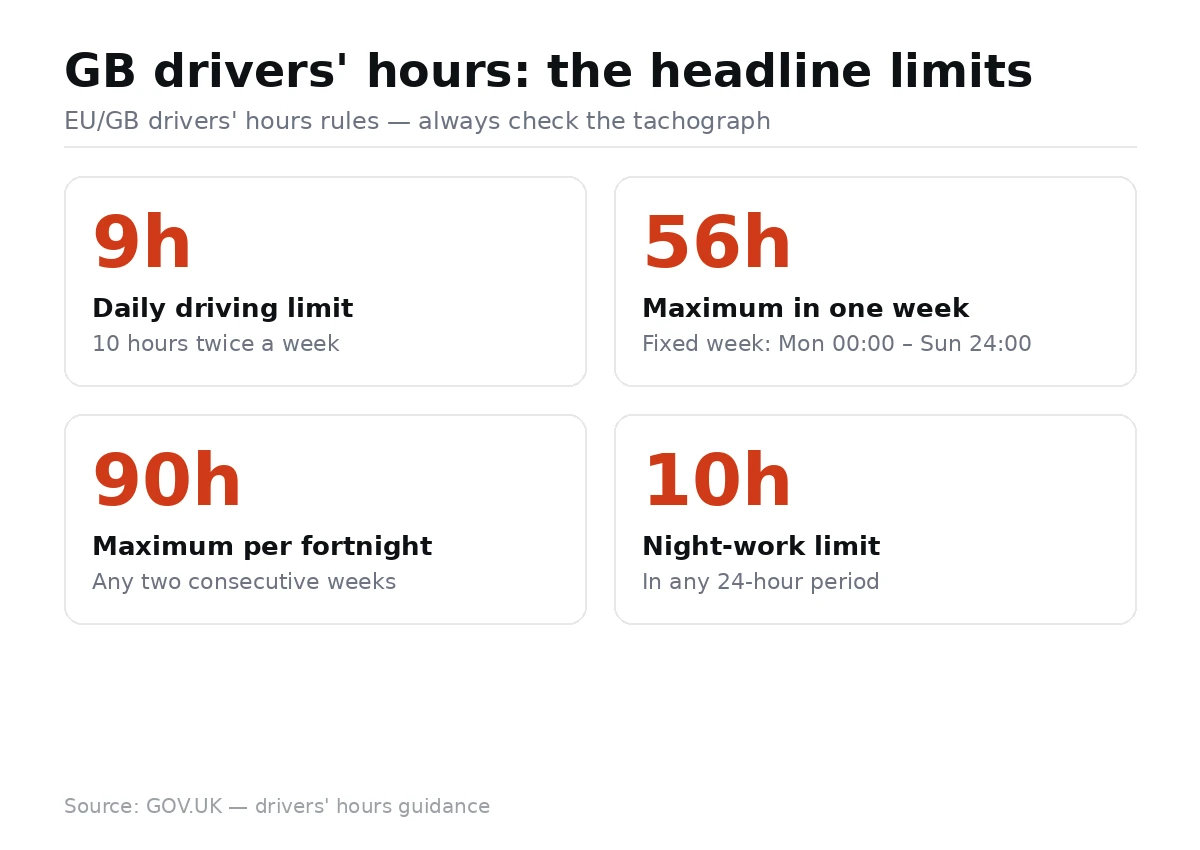
Daily driving is limited to 9 hours, extendable to 10 hours twice in a fixed week — and the fixed week runs from 00:00 on Monday to 24:00 on Sunday, not from whenever your shift pattern starts. Over the week, driving must not exceed 56 hours; over any two consecutive weeks, it must not exceed 90 hours. Those three numbers — 9/10, 56, 90 — are the skeleton of every compliant LGV rota in the country.
Inside the driving day sits the break rule: after 4.5 hours of driving you must take a break of at least 45 minutes, which may be split into a 15-minute break followed by a 30-minute break spread across the driving period. The split exists because real driving days are not continuous motorway runs — a delivery driver doing drops can take the 15 minutes at a customer and the 30 at the next stop — but the total has to reach 45 minutes before the next 4.5-hour block begins.
These are hard limits, not targets and not averages. Exceeding them is an offence, and the tachograph makes the evidence automatic: it records driving time, speed and distance continuously, and enforcement officers read it at the roadside and at operator premises. The consequences fall on both sides of the cab — the driver for the infringement, the operator for failing to organise the work so the rules could be kept.
Rest: the 11-hour rule and the weekly reset
Every 24-hour period must contain a daily rest of at least 11 consecutive hours. That rest can be reduced to 9 hours, but no more than three times between weekly rest periods — the reductions are a limited allowance for awkward rosters, not a standing permission to run on nine hours' sleep.
The weekly rest is normally 45 hours, and it can be reduced to 24 hours — but only every other week, and the reduction must be compensated. Compensation means an equivalent block of rest, taken en bloc, attached to another rest period of at least 9 hours, within three weeks of the reduced week. A 24-hour weekly rest that is never compensated is not a reduced rest; it is a breach with a three-week fuse on it.
This is the section of the rules that governs tramping life. A driver sleeping in the cab from Monday night to Friday morning lives or dies by the daily-rest arithmetic: 11 hours off between shifts, reducible to 9 three times, and a proper weekly rest at the end of it. When a tramping job's rota cannot show you where the 45-hour rests fall, the pay on offer is the least of its problems.
Working time: the 48-hour average and the 60-hour ceiling
The working-time rules cap the average week at 48 hours, measured over the reference period — 17 weeks as standard, extendable to 26 weeks where a collective or workforce agreement provides for it. On top of the average sits an absolute ceiling: no single week may exceed 60 hours of working time, however quiet the surrounding weeks were. The average smooths out busy and quiet periods; the ceiling stops any one week from becoming dangerous.
Here is the point most drivers have never been told: unlike the general Working Time Regulations that cover office and warehouse staff, the road transport rules have no opt-out. A warehouse operative can sign away the 48-hour average; a mobile worker in road transport cannot. An 'opt-out agreement' presented to an LGV driver at induction is worthless — the 48-hour average binds regardless of what was signed.
Self-employed drivers sometimes assume the rules stop at employment status. They do not: the self-employed have been covered by the working-time rules since 1 May 2012. Whether you are PAYE, agency or running your own limited company, the 48-hour average and the 60-hour ceiling apply to your working week. 'I'm self-employed, so the hours rules don't apply to me' has been wrong for over a decade.
Night work has its own ceiling
For goods vehicles, night work is defined as any work performed between 00:00 and 04:00. If you do any night work at all, your working time is capped at 10 hours in any 24-hour period — a stricter ceiling than the daytime rules allow. The only way past it is a collective or workforce agreement that expressly permits longer night working; without one, the 10-hour cap is absolute.
The working-time rules also set minimum breaks, separate from the driving breaks: 30 minutes when between 6 and 9 hours are worked, 45 minutes when more than 9 hours are worked, with each individual break lasting at least 15 minutes. In practice the driving-break rules and the working-time break rules usually run concurrently — a 45-minute break after 4.5 hours of driving satisfies both — but they are different requirements from different laws, and a rota has to satisfy each of them on its own terms.
The night-work cap is the reason night trunking rosters look the way they do: shifts engineered to land under 10 hours, with the premium — typically a few pounds an hour above the day rate — compensating for both the unsocial hours and the shorter shift. If a night role is offering twelve-hour shifts with no workforce agreement in place, the rota is the problem, not the pay.
What counts as working time — and what does not
Working time means time spent on activities directly connected with the transport operation: driving, of course, but also loading and unloading, cleaning and technical maintenance, supervising loading, completing paperwork and tachograph administration, and waiting time where the vehicle is being loaded or unloaded and the duration is not known in advance. If you are at the employer's disposal and cannot freely dispose of your time, it is working time.
What does not count is the 'period of availability': time spent waiting where the duration is known about in advance — the classic example is waiting at a depot or distribution centre for a scheduled loading slot — along with breaks, rest periods and time spent travelling to the place where you take over the vehicle. This is the boundary most disputes turn on: known-duration waiting is availability and does not count; unknown-duration waiting while the vehicle is being worked on does.
The tachograph sits underneath all of this as the proof of driving time, and it is mandatory on in-scope vehicles — it records driving time, speed and distance automatically. But the tachograph proves driving, not working: a driver can be fully compliant on the tacho and still breach the 60-hour working-time ceiling through loading, waiting and checks. Both records matter, and enforcement looks at both.
Van drivers and couriers: the lighter, separate regime
Goods vehicles up to 3.5 tonnes — the Transit or Sprinter a courier drives — sit under the GB domestic drivers' hours rules, a separate and lighter regime covered in its own section of the same GOV.UK guidance. The 9-hour, 56-hour and 90-hour numbers belong to the heavier regime; van work has its own limits, its own rest provisions and its own record-keeping, deliberately less onerous for lighter vehicles on shorter, local work.
Lighter does not mean unregulated, and it does not mean unprotected. The working-time protections still bite, the minimum wage still applies to every hour worked, and the economics of the work are unforgiving: the ONS median for delivery drivers and couriers is £12.85 an hour, just 14p above the £12.71 National Living Wage. A per-drop rate that looks generous on a dense round can fall below the floor on a sparse one, and the law measures the average across the pay period, not the best day.
When you are comparing a van role against an HGV role, you are comparing two different legal regimes as well as two pay packets. Ask which regime the job sits under before you compare the numbers: an HGV offer has the full assimilated rules and the tachograph behind it, a van offer has the domestic regime, and the protections, the paperwork and the enforcement are different in each.
Overtime, tramping allowances and the legal ceiling on extra hours
Overtime rates — time-and-a-half, double time on Sundays — are among the most familiar numbers in logistics, and they are also among the least protected. No statute requires an employer to pay a premium for your forty-ninth hour. Generous overtime multipliers are a contractual promise or a workplace custom, and they vary employer by employer. What your offer letter says is what you get; what 'the industry usually pays' is not enforceable.
What is enforceable is the ceiling the overtime sits under. No overtime rate, however generous, can make a 65-hour week legal: the 60-hour single-week maximum and the 48-hour average bind the employer as well as the driver. 'Plenty of overtime available' is a genuine feature of many logistics jobs, but it is only true up to the legal cap — and a rota that depends on routinely exceeding it is a rota built on breaches.
Tramping brings its own pay component: the nights-out allowance for sleeping in the cab. It is part of the pay picture and it affects take-home, but its tax treatment needs checking rather than assuming — allowances can be taxed through payroll like wages or treated as subsistence payments, and the two look identical on the advert while producing very different payslips. Ask directly, in writing, how the allowance is treated before you compare a tramping offer against a days role.
Agency drivers get the same legal protections with an extra administrative wrinkle: the hours limits attach to the driver, not the engager, so working time across every agency and every engager in the reference period counts toward the same 48-hour average. Keep your own log of hours across assignments — no single engager's timesheet shows your whole week, but the law measures the whole week.
How the rules bite in real rosters
Put the pieces together and the shape of a compliant LGV week emerges: up to 9 hours of driving a day (10 twice a week), 45-minute breaks after each 4.5-hour driving block, 11 hours of daily rest, a 45-hour weekly rest, total driving under 56 hours, total working time under 60 hours, and the whole pattern averaging 48 hours or less across the reference period. The worked example at the top of this guide shows a 46-hour driving week inside a 52-hour working week — legal on every count, and about as full as a week gets.
Most disputes do not start with the headline limits. They start with the grey areas: waiting time nobody recorded, loading counted as availability, a reduced weekly rest nobody compensated, a night shift that crept past 10 hours because the workforce agreement everyone assumed existed did not. The drivers who stay out of trouble are the ones who keep their own records — tacho printouts, timesheets, notes of waiting time — and who know which regime each hour of their week falls under.
If you are choosing between offers, the hours are part of the pay comparison, not separate from it. A days role at £15.50 an hour inside a clean 48-hour roster and a tramping role at £17 an hour with a rota that cannot show its weekly rests are not two prices for the same job. The second one is asking you to absorb legal risk as well as unsocial hours — and no premium is worth signing up to a rota that cannot be worked lawfully.
Driver hours and overtime FAQs
Are the drivers' hours rules and the working-time rules the same thing?
No — they are two different laws and both apply at once. The assimilated drivers' hours rules cap driving time for goods vehicles over 3.5 tonnes (9 hours a day, 10 twice a week, 56 a week, 90 a fortnight, with set breaks and rest). The Road Transport (Working Time) Regulations 2005 cap total working time for mobile workers at an average of 48 hours a week over the reference period, with a 60-hour absolute maximum in any single week. A week can be legal under one and illegal under the other.
How many hours a day can I legally drive?
Nine hours, extendable to 10 hours twice in a fixed week — and the fixed week runs from 00:00 on Monday to 24:00 on Sunday. After 4.5 hours of driving you must take a 45-minute break, which may be split into a 15-minute break followed by a 30-minute break. These are hard limits enforced through the tachograph, which records driving time, speed and distance automatically.
What is the maximum driving allowed in a week or a fortnight?
Driving must not exceed 56 hours in any fixed week (Monday 00:00 to Sunday 24:00) and must not exceed 90 hours over any two consecutive weeks. Both limits apply simultaneously — a fortnight of 56 plus 56 would breach the 90-hour rule even though each week individually looks fine.
How much rest do I have to take between shifts?
Daily rest is normally 11 consecutive hours in each 24-hour period, reducible to 9 hours no more than three times between weekly rest periods. Weekly rest is normally 45 hours, reducible to 24 hours — but only every other week, and the reduction must be compensated by an equivalent block of rest taken en bloc within three weeks. A reduced weekly rest that is never compensated is a breach.
Does waiting at a depot count as working time?
It depends on whether the duration was known in advance. Waiting where the duration is known — for example, waiting at a distribution centre for a scheduled loading slot — is a 'period of availability' and does not count as working time. Waiting where the duration is unknown, such as while the vehicle is being loaded or unloaded, does count. This boundary is where most working-time disputes start, so record waiting time yourself rather than relying on the rota to capture it.
Can I opt out of the 48-hour average working week?
No. Unlike the general Working Time Regulations, the road transport rules give mobile workers no opt-out — the 48-hour average over the reference period (17 weeks, extendable to 26 by agreement) binds regardless of anything signed at induction. The 60-hour maximum in any single week is absolute. Self-employed drivers have been covered by these rules since 1 May 2012.
What are the night-work limits for goods vehicle drivers?
For goods vehicles, night work means any work between 00:00 and 04:00. If you do any night work, your working time is capped at 10 hours in any 24-hour period, unless a collective or workforce agreement expressly allows more. Break entitlements under the working-time rules are 30 minutes when 6 to 9 hours are worked and 45 minutes when more than 9 hours are worked, with each break lasting at least 15 minutes.
Do the same drivers' hours rules apply to van drivers under 3.5 tonnes?
No — vans up to 3.5 tonnes sit under the GB domestic drivers' hours rules, a separate and lighter regime covered in its own section of the same GOV.UK guidance. The 9/56/90 driving limits belong to the heavier regime. But van drivers still have working-time protections, and the minimum wage applies to every hour worked — with the delivery-driver median at £12.85 an hour, just 14p above the £12.71 National Living Wage, there is almost no margin for under-recorded hours.
If my employer offers plenty of overtime, can I work as many hours as I want?
No. Overtime rates such as time-and-a-half are contractual customs, not legal rights — but the ceilings are legal and bind the employer as well as the driver: 60 hours maximum working time in any single week, and a 48-hour average over the reference period, with no opt-out for mobile workers. 'Plenty of overtime' is only true up to those caps. A rota that depends on routinely exceeding them is built on breaches, whatever the overtime multiplier.
Get pay-rise alerts by email
Pay scales move every April. We email once when the numbers change — no spam, no selling your address, unsubscribe any time.
Double opt-in: you will get a confirmation email before anything is sent.
Sources
- GOV.UK — Drivers' hours and tachographs: goods vehicles. Assimilated drivers' hours rules for goods vehicles over 3.5t: 9h daily driving (10h twice a week), 56h weekly and 90h fortnightly limits, 45-minute break after 4.5h driving (splittable 15+30), 11h daily rest (reducible to 9h up to 3 times), 45h weekly rest (reducible to 24h every other week, with compensation); tachograph mandatory, recording driving time, speed and distance; GB domestic rules for sub-3.5t vehicles covered in a separate section. Accessed 24 September 2026.
- GOV.UK — Working time rules: lorry, bus and coach drivers and crew. Road Transport Working Time Regulations 2005: 48h average weekly working time over a 17-week reference period (extendable to 26 by agreement), 60h maximum in any single week, no opt-out for mobile workers, night work (00:00–04:00 for goods vehicles) capped at 10h in any 24h, breaks of 30 minutes for 6–9h and 45 minutes over 9h, self-employed drivers covered since 1 May 2012, periods of availability not counted as working time. Accessed 24 September 2026.
- Legislation.gov.uk — The Road Transport (Working Time) Regulations 2005. SI 2005/639: the underlying regulations on working time for mobile workers in road transport. Accessed 24 September 2026.
- GOV.UK — National Minimum Wage and National Living Wage rates. National Living Wage £12.71 an hour for workers aged 21 and over from 1 April 2026. Accessed 24 September 2026.
- ONS — Annual Survey of Hours and Earnings 2025 (provisional). SOC 2020 medians, pay period April 2025, all employees: LGV drivers (SOC 8211) £16.00/hr; delivery drivers and couriers (SOC 8214) £12.85/hr. Weekly medians blend full-time and part-time hours. Accessed 24 September 2026.
- GOV.UK — Rates and allowances: UK income tax. 2026/27: £12,570 personal allowance; 20% basic rate to £50,270. Accessed 24 September 2026.
- GOV.UK — National Insurance. Employee Class 1 National Insurance at 8% on earnings between £12,570 and £50,270. Accessed 24 September 2026.
These are estimates for guidance only, not financial advice. Figures are taken from the sources listed above and were correct when this page was reviewed. Your actual pay depends on your contract, hours and tax code — check your payslip and HMRC guidance if anything looks off.