- LGV driver pay hub
£16.00/hr median: licences, tramping, night work and take-home figures for LGV drivers.
- Warehouse operative pay hub
£13.62/hr median: shift work, overtime and take-home for warehouse operatives.
- Delivery driver and courier pay hub
£12.85/hr median: per-drop rates, van work and take-home for delivery drivers and couriers.
- Fork-lift driver pay hub
£14.76/hr median: certification, shift patterns and take-home for fork-lift drivers.
- Driver hours and overtime pay explained
The two sets of hours law, night-work limits, tachographs — and where overtime fits inside the legal caps.
| Median hourly pay | Median weekly pay | Implied weekly hours (weekly ÷ hourly) | |
|---|---|---|---|
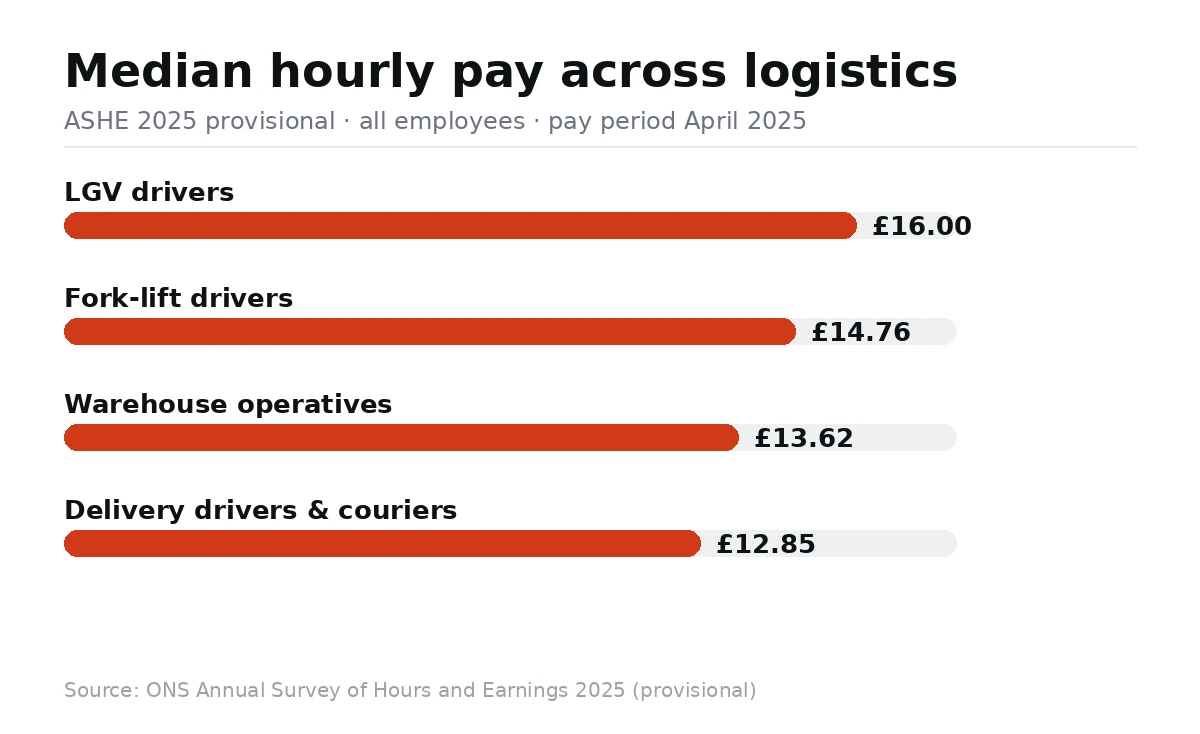
| LGV drivers (SOC 8211) | £16.00 | £781.50 | ~48.8 hours |
| Fork-lift truck drivers (SOC 8222) | £14.76 | £612.20 | ~41.5 hours |
| Warehouse operatives (SOC 9252) | £13.62 | £529.60 | ~38.9 hours |
| Delivery drivers and couriers (SOC 8214) | £12.85 | £495.80 | ~38.6 hours |
Why logistics pay is so hard to read
The LGV week only makes sense at 49 hours
£781.50 a week at £16.00 an hour implies a working week of 48.8 hours, and no standard full-time contract in Britain is written for 48.8 hours. The arithmetic is telling you something true about the occupation: LGV driving is a long-hours job, and the median weekly pay reflects weeks swollen by overtime, night shifts and tramping — sleeping in the cab through the week — rather than a high basic rate stretched over a normal week. The £16.00 hourly figure is respectable; the £781.50 weekly figure is what happens when respectable meets relentless.
The other three roles sit in a different world. Warehouse operatives at £529.60 a week and £13.62 an hour are working the equivalent of about 38.9 hours — a standard full-time week, more or less. Delivery drivers at £495.80 and £12.85 imply about 38.6 hours. Fork-lift drivers at £612.20 and £14.76 imply about 41.5, a full week plus a Saturday morning or a couple of late finishes. These are medians, not contracts, but the pattern is unmistakable: ordinary-length weeks at the lower-paid end of the sector, very long weeks at the top.
This is why the weekly medians need handling with care. They blend full-time staff with part-timers, so they understate what a full-time week at the hourly rate earns — and in LGV they simultaneously reveal that the 'typical' driver is working far beyond a standard week. When you compare offers, do what the table above does: take the weekly figure you are promised, divide it by the hourly rate, and ask yourself whether the implied hours are ones you actually want to work. An £800 week at £16 an hour is a 50-hour week wearing a pay packet as a disguise.
Shift premiums: the same job at a different hour pays differently
A large share of logistics work happens while the rest of the country is asleep, and employers pay for the inconvenience. Night shifts, weekend working and bank holidays typically carry premiums on top of the day rate — commonly an extra £1 to £3 an hour for nights, more for Sundays — though the exact structure varies by employer and there is no statutory scale. Two drivers at the same depot, on the same grade, can earn meaningfully different money simply because one works Tuesday days and the other works Friday nights.
The ONS medians fold all of this together: day drivers, night drivers, weekend workers and tramping drivers are all in the same £16.00 figure. That means your offer can sit above or below the median for entirely legitimate reasons. A days-only LGV role at £15.50 an hour is not underpaying against a £16.00 median that includes night-shift premiums; a night trunking role at £16.00 may be the one that is light. Always ask which shifts the quoted rate assumes — the advert's number and the rota's number are often two different numbers.
Premiums also interact with the hours law in a way drivers should understand. Night work for goods vehicle drivers — any work between midnight and 4am — caps working time at 10 hours in any 24-hour period unless a workforce agreement says otherwise. The premium exists because the shift is harder; the cap exists because it is. The driver-hours guide below sets out both in full.
Overtime is a custom; the ceiling is the law
Time-and-a-half after 40 or 48 hours, double time on Sundays: these are the familiar multipliers of logistics overtime, and they are contractual customs rather than legal rights. No statute requires an employer to pay a premium for your forty-ninth hour. Some employers pay generous overtime rates, some pay a flat rate for all hours, and both are lawful — what matters is what your contract or offer letter actually says, not what the industry 'usually' does.
But while the rate is custom, the ceiling is law, and it binds the employer as well as the driver. The Road Transport Working Time Regulations cap mobile workers at an average of 48 hours a week over the reference period, with an absolute maximum of 60 hours in any single week — and unlike the general working-time rules, there is no opt-out. An employer advertising 'plenty of overtime available' is describing something real, but it is only true up to the legal cap. The sixty-first hour of the week is not available at any price.
For anyone comparing offers, the questions to ask are concrete: after how many hours does the overtime rate start, what is the multiplier, is overtime guaranteed or offered at the employer's discretion, and how does the rota sit against the 48-hour average? A high overtime multiplier on hours you will never be rostered for is decoration; a modest one on guaranteed weekly overtime is money.
Agency rates flatter to deceive
Agency day rates look generous at first glance — £170 or £180 a day sounds like serious money next to a £15-an-hour employed role — until you annualise them. The day rate has to cover the weeks with no assignments, the holiday pay that may be rolled into the rate rather than paid on top, the absence of sick pay beyond the statutory minimum, and, where an umbrella company sits in the chain, its margin and the employer's National Insurance it deducts before the money reaches you. Employed drivers get continuity; agency drivers get a higher headline and carry the gaps themselves.
None of this makes agency work a bad deal in itself — flexibility and higher day rates suit plenty of drivers — but it makes the comparison treacherous. Two numbers that look £20 a day apart can reverse completely once a quiet fortnight, a week's unpaid holiday and an umbrella deduction have done their work. Ask any agency three things before you sign: is holiday pay rolled up in the rate or paid separately, what exactly comes out for the umbrella, and what happens to your pay in a week with no shifts.
One protection agency drivers do keep: the hours law follows the driver, not the engager. The 48-hour average and the 60-hour weekly maximum apply to your total working time across every engager in the reference period. An agency cannot roster you for hours that would breach the cap just because each individual assignment looks compliant on its own.
Per-drop pay has a legal floor
Couriers and some delivery drivers are not paid by the hour at all, but by the parcel or the drop — a rate per successful delivery, sometimes with a small base payment underneath. It is a lawful way to pay, and on a dense urban round with fifty drops it can beat the hourly equivalent. On a sparse rural round, in traffic, or in a week of failed deliveries and long waits at reception desks, it can quietly collapse.
The floor underneath it is the National Living Wage: £12.71 an hour for workers aged 21 and over from 1 April 2026. Piece rates must average out at or above that figure for every hour worked across the pay reference period — and 'hours worked' means all of them, including loading the van, driving between drops, waiting for access, and the return leg. An employer whose per-drop rate works out at £11 an hour on a slow week is not operating a clever incentive scheme; it is underpaying.
Set that against the delivery driver median of £12.85 an hour — just 14p above the legal floor. The typical courier's week leaves almost no margin between the going rate and the minimum, which is why the per-drop arithmetic matters so much in this corner of the sector. Before accepting per-drop work, ask experienced drivers on the same round how many drops an hour they actually complete, then do the division yourself.
Four jobs, four different bargains
The LGV premium — £16.00 an hour, £3.15 above the delivery median — is the price of the barrier to entry. A Category C or C+E licence costs thousands of pounds and weeks of training to obtain, the Driver CPC demands 35 hours of periodic training every five years, and the driver carries legal responsibility for a vehicle that can weigh 44 tonnes. Employers are not paying for the driving; they are paying for the licence, the compliance, and the scarcity of people who hold both.
Fork-lift drivers sit in the middle of the table for a similar reason. The £1.14-an-hour gap over warehouse operatives — £14.76 against £13.62 — is roughly the market price of an RTITB or ITSSAR certificate and the skill of moving pallets in tight racking without writing off the racking, the stock, or a colleague. It is the cheapest licence premium in the sector and one of the most reliable: almost every warehouse needs fork-lift drivers, and the certificate travels with the driver.
Warehouse operative is the entry point: no licence required, shift work, physically demanding, and the closest of the four roles to the wage floor at £13.62 an hour — 91p above the £12.71 minimum. Progression runs through the fork-lift certificate, then team leader and supervisor grades, each step carrying a clearer premium than the last. Delivery driving is the other entry point, with the lowest barrier of all — a standard car licence covers most courier vans — and the pay reflects it: £12.85, the sector's lowest median, in its most competitive labour market.
The annual figures and where the tax starts
Annualise the medians at a standard 37.5-hour week and the sector's shape sharpens: warehouse operatives £26,559 a year, delivery drivers £25,057.50, fork-lift drivers £28,782. The LGV figure annualises differently because the hours are different — the £781.50 median week, repeated across 52 weeks, comes to £40,638, a figure that already bakes in the long weeks rather than a high basic rate. Nobody earns the LGV median working 37.5 hours.
The tax position follows from the 2026/27 allowances: a £12,570 personal allowance, 20% income tax up to £50,270, and 8% employee National Insurance between £12,570 and £50,270. A warehouse operative at the £13.62 median on 37.5 hours grosses £26,559 and, after income tax, National Insurance and auto-enrolment pension contributions, takes home about £21,911 a year — roughly £1,826 a month. The take-home calculator on each role page runs the exact workings for any hours and rate.
One more number worth keeping in mind: the delivery median of £12.85 sits 14p above the National Living Wage. In the courier and delivery corner of the sector, the 'market rate' and the legal minimum are nearly the same figure — which means any underpayment of hours, any unpaid waiting time, any per-drop rate that does not divide out, lands the employer below the floor almost immediately.
Reading a logistics job advert like a payslip
Most logistics adverts are written to maximise applications, not to inform them, so the interview is where the real pay picture gets established. The questions that matter are the ones that convert every currency on the advert into the single one you will live on — and a good employer will answer all of them without hesitation. Treat vague answers as information: an operator who cannot tell you the overtime rate in the interview will not become more transparent after you have signed.
- How many hours a week are guaranteed, and after how many hours does the overtime rate start?
- Is the quoted rate the day rate — and what are the actual night, weekend and bank-holiday premiums?
- Agency or employed — and if agency, is holiday pay rolled into the rate or paid on top, and what does the umbrella deduct?
- For per-drop work: how many drops an hour do experienced drivers complete on this specific round?
- What counts as working time — loading, vehicle checks, waiting at the distribution centre?
- For tramping roles: is there a nights-out allowance, and is it taxed through payroll or paid as subsistence?
- How does the rota sit against the 48-hour average and the 60-hour weekly maximum?
About these figures
How the medians were compiled
All four roles' medians on this page come from the Office for National Statistics' Annual Survey of Hours and Earnings (ASHE) 2025 provisional release, pay period April 2025, all employees, Table 14 (four-digit occupations, SOC 2020): LGV drivers (SOC 8211) at £16.00 an hour and £781.50 a week; fork-lift truck drivers (SOC 8222) at £14.76 and £612.20; warehouse operatives (SOC 9252) at £13.62 and £529.60; and delivery drivers and couriers (SOC 8214) at £12.85 and £495.80. The implied weekly hours in the comparison table are the weekly median divided by the hourly median for each occupation, rounded to one decimal place.
A note on what 'all employees' means here: the ASHE sample covers employees on payrolls, and the weekly medians reflect the hours people actually work — including part-timers — not the hours a full-time contract would give. That is why the implied-hours arithmetic is shown explicitly rather than left for the reader to guess at. Genuinely self-employed drivers and couriers are not in the ASHE sample, so the delivery-driver figures describe employed couriers; the self-employed end of that market is not captured.
How to use this hub
Start with your role: the four role pages carry the rate detail, the day-to-day reality and the take-home workings for LGV drivers, warehouse operatives, delivery drivers and couriers, and fork-lift drivers. If nights, tramping or long weeks are part of the offer — and for LGV roles they usually are — read the driver-hours and overtime guide next; it is where the legal ceilings on your working week live, and no pay offer makes sense without them. The take-home calculator turns any rate and any hours into the monthly figure.
Logistics pay FAQs
How much do LGV drivers earn per hour in the UK?
The ONS Annual Survey of Hours and Earnings (2025 provisional, pay period April 2025) puts median hourly pay for LGV drivers at £16.00. The median weekly pay of £781.50 implies a working week of about 48.8 hours — long weeks, overtime and night work are baked into the figure. As with all medians, half of LGV drivers earn more and half earn less: nights, tramping and specialist work (tankers, hazardous goods) typically sit above the median, days-only general haulage often below it.
Why is the LGV weekly pay figure so high compared with the hourly rate?
Because the median LGV driver works long hours. Divide the £781.50 median weekly pay by the £16.00 median hourly rate and you get about 48.8 hours a week — far beyond a standard full-time week. The weekly figure reflects overtime, night shifts and tramping rather than a high basic rate, and it also blends in part-time drivers, which pulls it down from what full-time long-week drivers actually earn. The hourly rate is the anchor; the weekly figure is the hourly rate times the hours the median driver really works.
How does delivery driver pay compare with LGV driver pay?
The gap is £3.15 an hour at the median: £12.85 for delivery drivers and couriers against £16.00 for LGV drivers (ONS ASHE 2025 provisional). It reflects the barrier to entry — a standard car licence covers most courier vans, while LGV work needs a Category C or C+E licence, Driver CPC and tachograph compliance — and the weight of responsibility: a 44-tonne articulated lorry is a different proposition from a 3.5-tonne van. Delivery work is also commonly paid per drop rather than per hour, which adds variability the LGV hourly rate does not have.
Do warehouse operatives get overtime pay?
Overtime premiums such as time-and-a-half are a contractual custom in logistics, not a legal right — whether you get one, and after how many hours it starts, depends on your contract. What the law does set is the ceiling: mobile workers average a maximum of 48 hours a week over the reference period, with 60 hours the absolute maximum in any single week, and there is no opt-out. The warehouse weekly median of £529.60 implies roughly full-time hours (about 38.9 a week), so overtime above that is where warehouse pay has room to grow — within the legal cap.
Can a courier be paid per parcel instead of per hour?
Yes — piece rates are lawful, but they must average out at or above the National Living Wage of £12.71 an hour (21+, from 1 April 2026) for every hour worked across the pay reference period, including loading, driving between drops, waiting and the return leg. With the delivery-driver median sitting at £12.85 an hour — just 14p above the floor — there is almost no margin for a per-drop rate that does not divide out. If the rate leaves you below £12.71 an hour on a slow week, the employer is underpaying whatever the contract says.
Get pay-rise alerts by email
Pay scales move every April. We email once when the numbers change — no spam, no selling your address, unsubscribe any time.
Double opt-in: you will get a confirmation email before anything is sent.
Sources
- ONS — Annual Survey of Hours and Earnings 2025 (provisional). SOC 2020 medians, pay period April 2025, all employees: LGV drivers (SOC 8211) £16.00/hr and £781.50/wk; fork-lift truck drivers (SOC 8222) £14.76/hr and £612.20/wk; warehouse operatives (SOC 9252) £13.62/hr and £529.60/wk; delivery drivers and couriers (SOC 8214) £12.85/hr and £495.80/wk. Weekly medians blend full-time and part-time hours. Accessed 24 September 2026.
- GOV.UK — National Minimum Wage and National Living Wage rates. National Living Wage £12.71 an hour for workers aged 21 and over from 1 April 2026. Accessed 24 September 2026.
- GOV.UK — Drivers' hours and tachographs: goods vehicles. Assimilated drivers' hours rules for goods vehicles over 3.5t: 9h daily driving (10h twice a week), 56h weekly and 90h fortnightly driving limits, 45-minute break after 4.5h driving, daily and weekly rest requirements; tachograph mandatory. Accessed 24 September 2026.
- GOV.UK — Working time rules: lorry, bus and coach drivers and crew. Road Transport Working Time Regulations 2005: 48h average weekly working time over the reference period, 60h maximum in any single week, no opt-out for mobile workers, night-work limits and break entitlements. Accessed 24 September 2026.
- Legislation.gov.uk — The Road Transport (Working Time) Regulations 2005. SI 2005/639: the underlying regulations on working time for mobile workers in road transport, including the 48-hour average, the 60-hour weekly maximum and periods of availability. Accessed 24 September 2026.
These are estimates for guidance only, not financial advice. Figures are taken from the sources listed above and were correct when this page was reviewed. Your actual pay depends on your contract, hours and tax code — check your payslip and HMRC guidance if anything looks off.