An illustrative domiciliary round: how between-visit travel time adds up
| Client visits in a day | 6 (30–45 minutes each) |
| Journeys between visits | 5 × 20 minutes = 1 hour 40 minutes |
| Travel time at the £13.45 median hourly rate | £22.42 a day |
| Across a 5-day week | £112.10 of working time |
| Legal status of that travel time | Working time for minimum-wage purposes (Reg 20, NMW Regulations 2015) |
Sleep-ins, travel time and mileage: the complete guide
What a sleep-in shift actually is
A sleep-in means what it says: you sleep at the service overnight so that someone is on the premises if a resident needs help. The bedroom might be a dedicated staff room in a care home or a spare room in a supported-living house. You arrive in the evening, you are available through the night, you sleep — or try to — and you hand over in the morning. The defining feature is availability, not activity: you are there in case, not there doing.
In practice the night is rarely as quiet as the job description suggests. A resident has a fall at 2am, someone with dementia becomes distressed and needs an hour of company, a buzzer goes at four and again at five. Some sleep-ins pass without a single callout; others turn into most of a night's work in fragments. The unpredictability is the point of the role — the service needs a person, not a phone line — and it is also the reason paying for sleep-ins has caused a decade of legal argument.
Do not confuse a sleep-in with a waking night. A waking night shift means you are awake and on duty for the whole shift — doing rounds, administering medication, writing notes — and it is paid as normal working time at your hourly rate. A sleep-in pays differently precisely because most of it is spent asleep. If your rota says 'sleep-in' but you are expected to stay awake doing tasks all night, that is a waking night by another name, and it should be paid as one.
How sleep-ins are usually paid
Most providers pay sleep-ins as a flat rate per shift rather than an hourly rate. It appears as its own line on the payslip — 'sleep-in allowance' or similar — separate from your contracted hours. The rate is set by the employer, and it varies widely: some providers pay generously, some pay the least they believe the law allows, and the difference between the two can be the difference between a viable job and one that only looks viable on the advert.
The flat rate exists because the alternative — paying the full hourly rate for eight or nine hours of mostly sleeping — would make sleep-in cover ruinously expensive for providers operating on local-authority fee rates. Whether that is fair to the worker is exactly what the courts were asked to decide, and the answer they gave shapes everything below. The flat rate is not a loophole an employer invented; it is the market's response to what the law permits.
What you should expect to see on the payslip is transparency: the number of sleep-ins worked, the rate per sleep-in, and the total, each on its own line. What you should not see is sleep-in hours folded silently into your contracted hours at your day rate, or missing entirely. If sleep-ins appear nowhere on your payslip, ask — the money may be bundled into a salary in a way that makes the minimum-wage arithmetic impossible to check, which helps nobody except the person who set it up that way.
The sleep-in ruling that settled the minimum-wage question
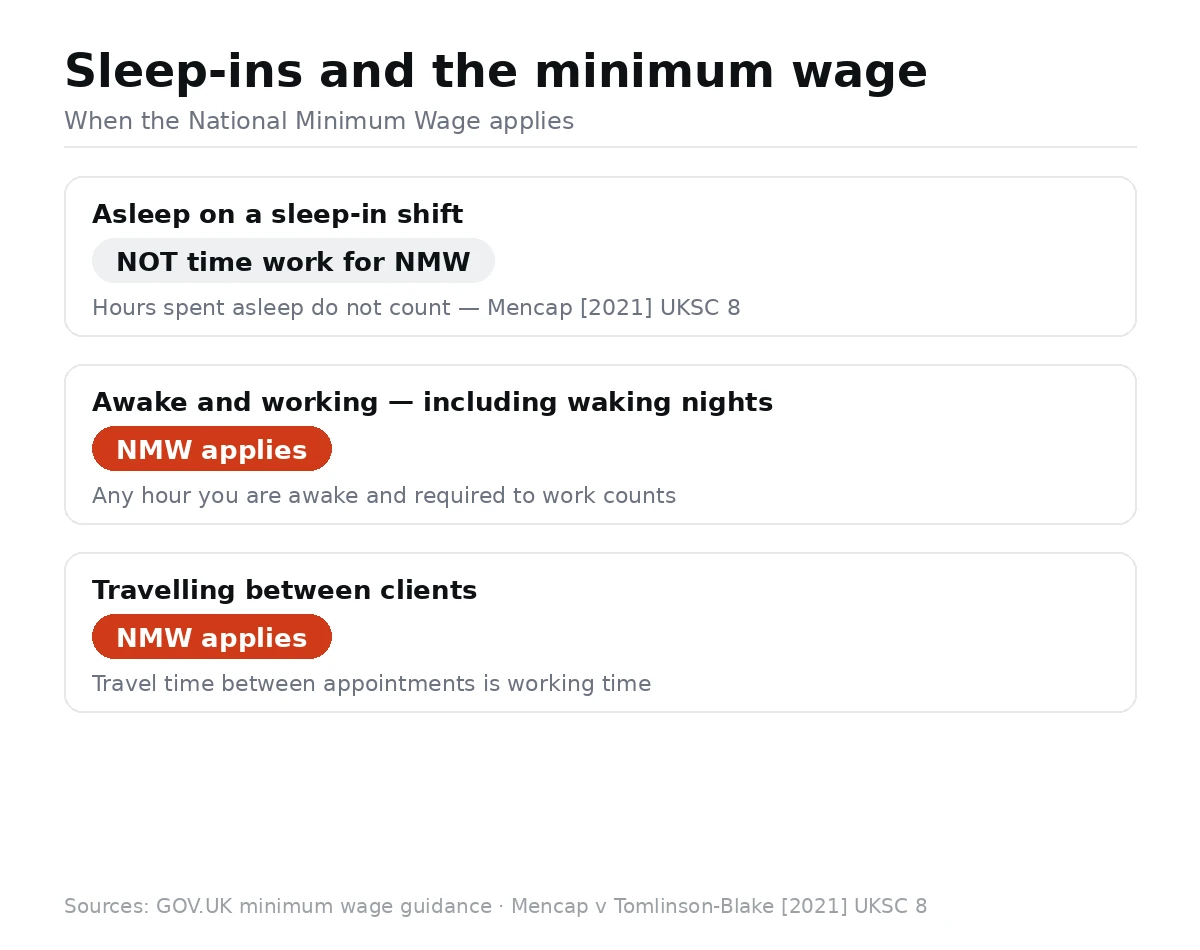
The legal position on sleep-ins was settled by the Supreme Court in Royal Mencap Society v Tomlinson-Blake [2021] UKSC 8. The court held that a care worker on a sleep-in shift is not doing 'time work' for minimum-wage purposes while asleep. Only time actually spent awake for the purposes of working — getting up to deal with a resident, for example — counts as working time. The hours spent sleeping do not, even though the worker is required to be on the premises.
That is the whole ruling in one paragraph, and it is worth understanding precisely because it disappoints both sides. It means an employer can lawfully pay a flat sleep-in rate that works out below the National Living Wage for the sleeping hours. But it also means the employer cannot pretend the whole night is non-working time: every minute you are up and working during a sleep-in is working time, paid at no less than the minimum, and it counts toward the hours in the minimum-wage calculation.
Two things to know about where this stands now. First, the ruling has not been overturned and remains the law: the Employment Rights Act 2025 creates a Fair Pay Agreement mechanism for adult social care, expected around April 2028, which is about sector-wide pay bargaining — it does not reverse the Supreme Court's decision on what counts as working time. Second, none of this stops an employer paying more than the legal minimum for sleep-ins, and many do: the ruling sets a floor, not a going rate.
Travel time between appointments counts as working time
If you do domiciliary care — visiting people in their own homes — your working day is mostly travel with care visits in between. The law is explicit about how that travel is treated: regulation 20 of the National Minimum Wage Regulations 2015 provides that time spent travelling between assignments counts as working time. The twenty minutes between Mrs Ahmed's house and the next call is not your lunch break and not your problem; for minimum-wage purposes, it is work.
This is the rule that catches out the most employers, usually without malice. A rota system books back-to-back thirty-minute visits with no travel allowance between them; the carer drives, unpaid, for two hours a day; the payslip shows the visits at £13.45 an hour and nothing else. The headline rate is honest and the pay packet is short, because a quarter of the working day never made it onto the payslip. If your employer pays your full rate for travel time, none of this bites — the rule matters precisely where travel is unpaid or underpaid.
What the rule does not cover is commuting. The journey from your home to your first appointment of the day, and from your last appointment back home, is not working time under the regulations — it is treated like any other commute. The boundary can feel arbitrary when the first call is forty minutes away, but it is the boundary the law draws. Everything between the first and last appointment of the day is working time; the bookends are not.
Mileage: the 55p rate and what it actually covers
Driving between clients costs real money — fuel, tyres, servicing, insurance, and the depreciation of a car doing 15,000 care miles a year. HMRC's approved mileage rates are meant to cover it: for the 2026/27 tax year, 55p a mile for cars and vans for the first 10,000 business miles, and 25p a mile for every mile after that. The 55p rate took effect on 6 April 2026, raised from 45p — the first increase since 2011, after fifteen years in which the rate stood still while every cost of motoring climbed.
The approved rate is a tax-free ceiling, not a legal minimum. Your employer does not have to pay the full 55p — but anything it does pay up to that rate is tax-free, and if it pays less than 55p you can claim tax relief on the shortfall. In money terms: an employer paying 35p a mile leaves 20p a mile of approved rate unclaimed, and you can get basic-rate tax relief on that 20p. Few carers know this, and fewer claim it — which is a quiet pay cut most people never notice.
Two practical points. First, keep a mileage log: date, start and end points, miles, purpose. It is the evidence for reimbursement claims, for tax-relief claims, and for any dispute about what you are owed. Second, check where mileage appears on your payslip. It should be a separate expenses line, not folded into your hourly pay. Mileage money reimburses costs you have already incurred; counting it as wages when working out whether you earn the minimum is one of the oldest tricks in the sector's book, and the regulations do not allow it.
Reading your payslip line by line
A care worker's payslip should tell a complete story, and most of the disputes in this guide start with a payslip that does not. The lines to look for: contracted or guaranteed hours at your hourly rate; any overtime or additional hours; sleep-in shifts as a separate line showing the number of shifts and the rate per shift; travel time, if your employer pays it separately; mileage as an expenses reimbursement, not as pay; and then the deductions — income tax, National Insurance, pension contributions, and anything else.
The deductions deserve a moment. Income tax and National Insurance are calculated on your pay, not your expenses: mileage reimbursement should not be taxed, and if it appears to have been, the payroll is wrong. Auto-enrolment pension contributions come out of qualifying earnings — for a full-time care worker at the £13.45 median, that is £999.38 a year, or about £83 a month. Small, easy to ignore, and compounding for decades: check it is actually being paid into a pension and not just deducted.
Then do the one piece of arithmetic that matters. Add up every hour you actually worked in the pay period — visits, travel between visits, time awake and working during sleep-ins, training, handovers — and divide your gross pay (excluding mileage expenses) by that total. If the answer is below £12.71 an hour, the National Living Wage, something is wrong. Minimum-wage law works on averages across the pay period, so a single bad week does not prove a breach — but a pattern across the month does.
When the numbers do not add up
If the arithmetic points to a shortfall, start with records, not accusations. Most underpayment in care is administrative rather than malicious: a rota system that never booked travel time, sleep-ins recorded as eight hours when you were up for three of them, mileage logged late or not at all. A fortnight of your own contemporaneous notes — times, journeys, callouts — is worth more than a year's worth of suspicion.
Raise it with the employer in writing, with the numbers. 'In the four weeks to 30 June I worked 172 hours including 31 hours of between-visit travel and 6 hours awake during sleep-ins; my gross pay excluding mileage was £2,048, which is £11.91 an hour against a £12.71 minimum' is a letter that gets answered. 'I think my pay is wrong' is a conversation that gets forgotten. Employers who value their CQC rating take written minimum-wage queries seriously, because the regulator does too.
If the employer does not put it right, you are not without options. ACAS offers free, confidential advice on pay disputes and what to do next. HMRC enforces the minimum wage and can investigate on the basis of a complaint — workers can report underpayment without the employer knowing who complained. Citizens Advice can talk through the whole picture, including whether the contract terms themselves are the problem. None of these steps costs anything, and all of them start with the records you kept.
Questions to ask before you take a care job
The interview is the cheapest time to discover how a provider handles the three things in this guide. Ask directly, and treat vague answers as answers — a provider that cannot tell you its sleep-in rate or its mileage rate in the interview will not become more transparent once you have signed.
- What is the sleep-in rate, how often would I be expected to do sleep-ins, and is there a separate waking-night rate?
- Is travel time between visits paid, and if so at what rate — the full hourly rate, a lower rate, or not at all?
- What is the mileage rate, is it paid from the office or door to door, and how do I submit claims?
- How many hours a week are guaranteed, and how are additional or bank hours offered and paid?
- How is holiday pay calculated for my contract type, and where does it appear on the payslip?
- What does a typical week's payslip look like — can I see a sample with the sleep-in, travel and mileage lines?
- Who keeps the records of my hours, and can I see them if I think the payslip is wrong?
Sleep-in, travel time and mileage FAQs
Do I have to be paid the National Living Wage for sleep-in shifts?
Not for the hours you spend asleep. The Supreme Court held in Royal Mencap Society v Tomlinson-Blake [2021] that a care worker on a sleep-in is not doing 'time work' for minimum-wage purposes while asleep — only time actually spent awake for the purposes of working counts. Most providers pay a flat rate per sleep-in. What the law requires is that your average hourly pay across the pay period, for all the hours you actually worked — including time awake during sleep-ins and travel time between appointments — stays at or above the National Living Wage of £12.71 an hour.
Is travel time between clients paid?
For minimum-wage purposes it must be counted: regulation 20 of the National Minimum Wage Regulations 2015 treats time spent travelling between assignments as working time. Whether your employer pays your full hourly rate for it, a lower rate, or nothing separately is a matter of contract — but the minimum-wage calculation includes it regardless. So if unpaid travel drags your average hourly pay below £12.71, the employer is in breach whatever the contract says. The commute from home to your first appointment and back from your last does not count.
What mileage rate should my employer pay?
HMRC's approved rates for 2026/27 are 55p a mile for cars and vans for the first 10,000 business miles in a tax year, then 25p a mile — raised from 45p on 6 April 2026. Employers are not legally required to pay the full approved rate, but anything paid up to it is tax-free, and if yours pays less you can claim tax relief on the difference. Keep a mileage log with dates, journeys and miles: it is the evidence for reimbursement claims, tax-relief claims and any dispute.
What is the difference between a sleep-in and a waking night?
A sleep-in means you sleep on the premises and are available if needed; you are paid a flat rate per shift, and the sleeping hours do not count as working time for minimum-wage purposes. A waking night means you are awake and on duty for the whole shift — rounds, medication, notes — and it is paid as normal working time at your hourly rate. If your rota says 'sleep-in' but you are expected to stay awake working all night, that is a waking night by another name and should be paid as one.
How do I work out if my pay meets the minimum wage?
Add up every hour you actually worked in the pay period — client visits, travel between visits, time awake and working during sleep-ins, training and handovers — and divide your gross pay (excluding mileage expenses) by that total. Minimum-wage law works on averages across the pay period, so compare the result with the National Living Wage of £12.71 an hour. If it is consistently below, raise it with your employer in writing with the numbers, and if that fails, ACAS and HMRC's minimum-wage enforcement can help — reporting to HMRC can be done without the employer knowing who complained.
What should a sleep-in show as on my payslip?
Its own line: the number of sleep-ins worked, the rate per sleep-in, and the total — separate from your contracted hours. Travel time, if paid separately, should also be identifiable, and mileage should appear as an expenses reimbursement, not as wages. If sleep-ins appear nowhere, or everything is bundled into a single salary figure, the minimum-wage arithmetic cannot be checked — ask for an itemised breakdown in writing.
Will the Fair Pay Agreement change sleep-in pay?
Not the legal position on what counts as working time. The Employment Rights Act 2025 creates a Fair Pay Agreement mechanism for adult social care — sector-wide pay bargaining, expected around April 2028 — but it does not overturn the Supreme Court's 2021 ruling that sleeping hours on a sleep-in are not 'time work' for minimum-wage purposes. A Fair Pay Agreement could in future set higher sector pay rates, which would change what sleep-ins are worth in practice, but the ruling itself stands.
Where do I go if my pay looks wrong?
Start with your own records — a fortnight of contemporaneous notes on hours, journeys and sleep-in callouts — then raise it with your employer in writing, with the numbers. If that does not resolve it: ACAS gives free, confidential advice on pay disputes; HMRC enforces the minimum wage and investigates complaints; Citizens Advice can review the whole picture including your contract terms. Keep copies of every payslip and every letter: paper wins pay disputes.
Get pay-rise alerts by email
Pay scales move every April. We email once when the numbers change — no spam, no selling your address, unsubscribe any time.
Double opt-in: you will get a confirmation email before anything is sent.
Sources
- GOV.UK blog — Sleep-in shifts in social care. Supreme Court judgment in Royal Mencap Society v Tomlinson-Blake [2021] UKSC 8: a care worker on a sleep-in shift is not doing time work for minimum-wage purposes while asleep; only time actually awake for the purposes of working counts. Accessed 24 September 2026.
- GOV.UK — National Minimum Wage and National Living Wage rates. National Living Wage £12.71 an hour for workers aged 21 and over from 1 April 2026. Accessed 24 September 2026.
- GOV.UK — Tax relief for employees: vehicles you use for work. HMRC approved mileage rates for 2026/27: 55p a mile for cars and vans for the first 10,000 business miles, 25p a mile thereafter; raised from 45p on 6 April 2026, the first change since 2011. Accessed 24 September 2026.
- ONS — Annual Survey of Hours and Earnings 2025 (provisional). SOC 2020 medians, pay period April 2025, all employees: care workers and home carers (SOC 6135) £13.45/hr; senior care workers (SOC 6136) £14.20/hr. Accessed 24 September 2026.
These are estimates for guidance only, not financial advice. Figures are taken from the sources listed above and were correct when this page was reviewed. Your actual pay depends on your contract, hours and tax code — check your payslip and HMRC guidance if anything looks off.