- Care worker and home carer pay hub
£13.45/hr median: the role, the rates, and take-home figures for care workers and home carers.
- Senior care worker pay hub
£14.20/hr median: rates, responsibilities and take-home for senior care workers.
- Sleep-ins, travel time and mileage explained
How sleep-in shifts are paid, when travel time counts as working time, and the 55p mileage rate.
- Take-home pay calculator
Hourly rate or salary in, monthly take-home out — worked on the 2026/27 UK tax model.
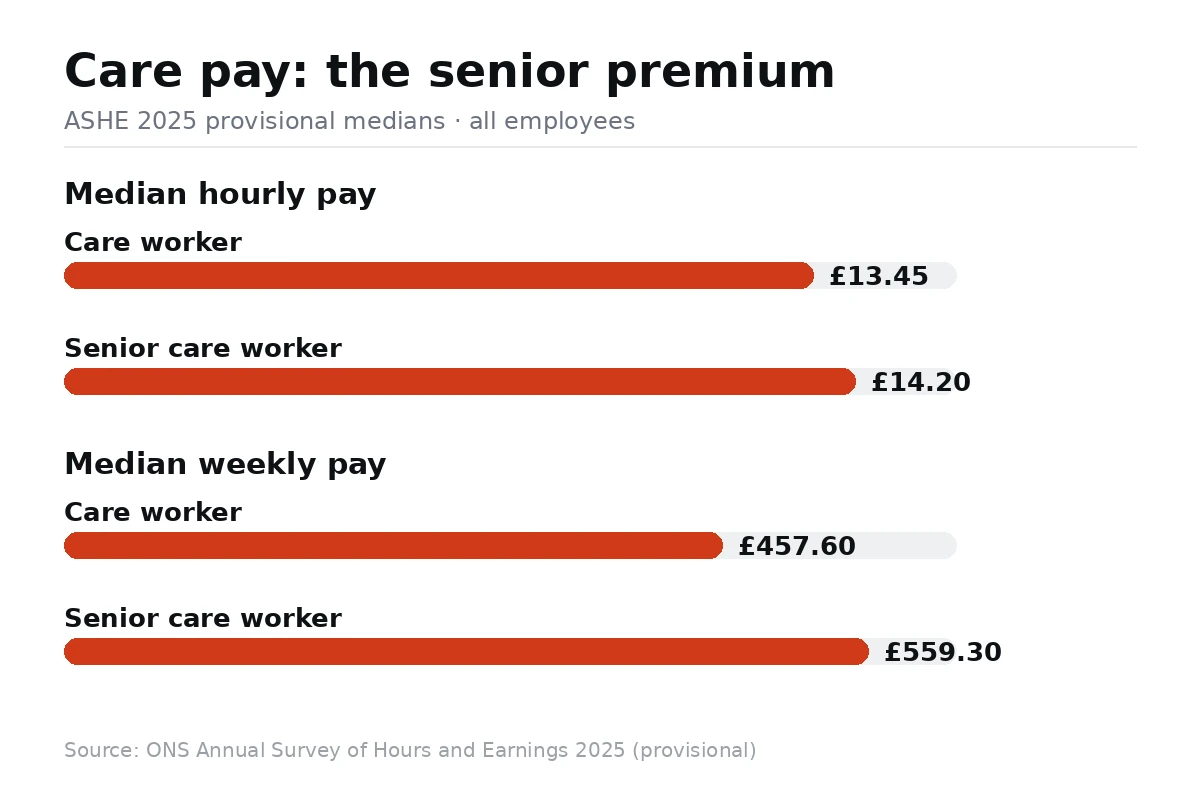
| Median hourly pay | Median weekly pay (blended part-time) | Weekly at 37.5 hrs (derived) | |
|---|---|---|---|
| Care workers and home carers (SOC 6135) | £13.45 | £457.60 | £504.38 |
| Senior care workers (SOC 6136) | £14.20 | £559.30 | £532.50 |
Why care pay is so hard to read
The hourly rate is the anchor; the weekly figure is not
The gap between £457.60 and £504.38 is the whole story of care pay in one line. The first is the ONS median weekly pay for care workers and home carers; the second is what 37.5 hours at the £13.45 median hourly rate actually comes to. The difference is not an error — the weekly median blends full-time staff with the large share of the workforce on part-time contracts, bank work and school-hours rotas. If you work full-time hours, the weekly median understates what the hourly rate earns you by the best part of £50 a week.
This matters when you are comparing offers. Job adverts quote hourly rates, the statistics quote weekly medians, and neither tells you what your bank account will see until you know your contracted hours. A 30-hour week at £13.45 is £403.50 a week; a 37.5-hour week is £504.38; both are the same 'rate'. Before you accept any care role, multiply the hourly figure by your actual contracted hours — that is the number you will live on, not the median in a table.
The same caution applies in reverse. A senior care worker's weekly median of £559.30 looks like a comfortable step up from £457.60, but the hourly gap is only 75p — £14.20 against £13.45. A chunk of the weekly difference comes from seniors working longer average hours, not from a meaningfully higher rate. Compare hourly with hourly, weekly with weekly, and always ask how many hours are guaranteed.
The two roles: what separates a care worker from a senior
The statistics divide care into two occupations, and employers mostly do too. Care workers and home carers (SOC 6135) do the hands-on work: personal care, medication prompts, meal support, companionship, and the domestic tasks that keep someone living independently — in care homes, in supported living, and in people's own homes on domiciliary rounds. It is the larger group by a wide margin and the entry point for almost everyone in the sector.
Senior care workers (SOC 6136) do the same work with responsibility on top: leading shifts, supervising care workers, handling medication administration, writing and reviewing care plans, and being the point of contact for families and inspectors. The step up is real — a senior carries accountability a care worker does not — which is why the 75p hourly premium exists. In practice it is the first rung of a career ladder: team leader, deputy manager, registered manager.
The two role pages break this down properly: what each job actually involves day to day, what the rate gets you after tax, and what the progression looks like. If you are choosing between a care worker offer and a senior role, the decision is not really about 75p an hour — it is about whether you want the responsibility that comes with it, and whether the employer will train you for the medication and care-planning duties the senior title requires.
Sleep-ins: a shift paid by the night, not the hour
A sleep-in is not a night shift. You sleep at the service overnight — in a staff room or a spare bedroom — so that someone is on the premises if a resident needs help. You are asleep for most of it, on paper. In practice you might be up twice with a distressed resident, or not at all. The pay reflects that ambiguity: most providers pay a flat rate per sleep-in rather than an hourly rate, shown as a separate line on the payslip.
This is also the most legally argued-over shift in the sector. The Supreme Court ruled in Royal Mencap Society v Tomlinson-Blake [2021] that a care worker on a sleep-in is not doing 'time work' for minimum-wage purposes while asleep — only time actually spent awake for the purposes of working counts. That ruling still stands: a Fair Pay Agreement mechanism for adult social care is expected around April 2028 under the Employment Rights Act 2025, but it does not overturn the decision.
What that means in plain terms: an employer can lawfully pay a flat rate for a sleep-in that works out below the hourly minimum for the sleeping hours, provided that across the pay period your average hourly pay for the hours you actually worked — including time awake during sleep-ins and travel time between appointments — stays at or above the National Living Wage of £12.71 an hour. The sleep-in guide walks through exactly how that arithmetic works and what to look for on your payslip.
Travel time counts — commuting does not
Domiciliary care — home care, visiting people in their own homes — runs on travel. A typical round might mean six visits and five journeys between them, and those journeys are not your problem to absorb: regulation 20 of the National Minimum Wage Regulations 2015 treats time spent travelling between assignments as working time. It counts toward the hours your employer must pay at least the minimum wage for.
What does not count is commuting: the journey from home to your first appointment and from your last appointment back home is not working time under the same rules. The line is clear in principle and blurry in practice — a carer whose 'first appointment' is forty minutes away starts every day with forty unpaid minutes — but the legal position is that between-client travel is work and the commute is not.
The reason this matters so much is that minimum-wage compliance is assessed on averages. If your pay divided by all your working hours — visits plus between-visit travel, plus any time awake on sleep-ins — drops below £12.71 an hour, the employer has a problem regardless of what the advert said the hourly rate was. A £13.45 headline rate with two unpaid travel hours a day is not a £13.45-an-hour job in the eyes of the law.
Mileage: 55p a mile, and why the rate just changed
If you drive between clients in your own car, the mileage money is not a perk and it is not wages — it is reimbursement for the cost of running the vehicle. HMRC sets the approved rates: for 2026/27 it is 55p a mile for cars and vans for the first 10,000 business miles in a tax year, then 25p a mile after that. The 55p figure took effect on 6 April 2026, raised from 45p — the first change since 2011, after fifteen years in which fuel, insurance and servicing costs all climbed while the rate stood still.
The rate is a ceiling for tax-free reimbursement, not a legal minimum your employer must pay. Employers can pay less — some do — but anything up to the approved rate can be paid tax-free, and if your employer pays below it you can claim tax relief on the difference. What matters most is keeping records: date, journey, miles. Without a log, neither reimbursement claims nor tax relief claims survive contact with reality.
Watch the payslip, too. Mileage payments should appear as expenses, separate from your pay — they are not wages and should not be counted as such when anyone works out whether you are earning the minimum wage. An employer who folds mileage into the hourly rate and calls it pay is dressing up reimbursement as earnings.
Part-time hours and the annual figure that matters
Care runs on part-time and variable hours to a degree most sectors do not. School-hours contracts, weekend-only rotas, bank and zero-hours arrangements: all common, all legitimate, all capable of making the headline rate meaningless. £13.45 an hour is £26,227.50 a year at 37.5 hours a week — but it is £13,996.80 at 20 hours, and it is nothing at all in a week with no shifts. The rate is only half the offer; the hours are the other half.
Variable-hours workers should pay particular attention to holiday pay and sick pay. Accrued holiday is a legal entitlement whatever the contract type, and for irregular-hours workers it is calculated from actual hours worked — which means your employer's records of your hours are also the records of your holiday entitlement. If the hours on your payslip do not match the hours you worked, two separate entitlements are wrong at once.
The annual figure is also the one that decides your tax position. A full-time care worker at the £13.45 median grosses £26,227.50 a year and takes home £21,683.85 — £1,806.99 a month — after income tax, National Insurance and auto-enrolment pension contributions. A senior at £14.20 grosses £27,690.00 and takes home £22,684.20, or £1,890.35 a month. Those are the numbers the take-home calculator on the role pages produces, and they are the ones to budget against — not the hourly rate, not the weekly median.
About these figures
How the medians were compiled
The hourly and weekly medians on this page come from the Office for National Statistics' Annual Survey of Hours and Earnings (ASHE) 2025 provisional release, pay period April 2025, all employees. The two occupations follow Standard Occupational Classification 2020 codes: care workers and home carers (SOC 6135) at £13.45 an hour and £457.60 a week, and senior care workers (SOC 6136) at £14.20 an hour and £559.30 a week. The derived full-time weekly figures — £504.38 and £532.50 — are 37.5 times the hourly median, rounded to the nearest penny.
A note on what 'all employees' means here: the ASHE sample covers employees on payrolls, including the large part-time and variable-hours workforce that defines the sector. That is exactly why the weekly medians sit well below the hourly rate multiplied by full-time hours — they reflect the hours people actually work, not the hours a full-time contract would give. Genuinely self-employed carers are not in the ASHE sample.
How to use this hub
Start with your role: the care worker page and the senior care worker page carry the rate detail, day-to-day reality and take-home workings for each. If sleep-ins, travel time or mileage are part of your working life — and for most carers at least one of them is — read the sleep-in and travel pay guide next; it is where the rules that actually decide your wage live. The take-home calculator turns any salary or hourly rate into the monthly figure.
Care worker pay FAQs
How much do care workers get paid per hour in the UK?
The ONS Annual Survey of Hours and Earnings (2025 provisional, pay period April 2025) puts median hourly pay at £13.45 for care workers and home carers and £14.20 for senior care workers. Those are all-employee medians, so half of care workers earn more and half earn less. The rate on any given job advert can sit above or below the median depending on the employer, the setting and the region — but the hourly figure, not the weekly one, is the number to compare offers against, because the weekly medians blend full-time and part-time staff.
Why is the weekly pay figure lower than the hourly rate times 40?
Because the weekly medians blend full-time and part-time workers, and care is a heavily part-time sector. The median weekly pay of £457.60 for care workers reflects the hours people actually work — many are on part-time, school-hours or variable-hours contracts — while £13.45 times 37.5 hours comes to £504.38. Neither figure is wrong; they measure different things. If you work full-time hours, ignore the weekly median and do the maths on the hourly rate times your contracted hours.
Are sleep-in shifts paid the National Living Wage for every hour?
No — not for the hours you spend asleep. The Supreme Court ruled in Royal Mencap Society v Tomlinson-Blake [2021] that a care worker on a sleep-in shift is not doing 'time work' for minimum-wage purposes while asleep; only time actually spent awake for the purposes of working counts. Most providers pay a flat rate per sleep-in rather than an hourly rate. What the law does require is that your average hourly pay across the pay period — for all the hours you actually worked, including time awake during sleep-ins and travel time between appointments — stays at or above the National Living Wage of £12.71 an hour.
Do care workers get paid for travel time between clients?
For minimum-wage purposes, yes: regulation 20 of the National Minimum Wage Regulations 2015 treats time spent travelling between assignments as working time, so it counts toward the hours your employer must pay at least the minimum wage for. Whether your employer pays your full hourly rate for that travel, a lower rate, or nothing separately depends on your contract — but the minimum-wage calculation includes it either way. The journey from home to your first appointment and from your last appointment home is commuting and does not count.
What is the take-home pay of a care worker on £13.45 an hour?
At 37.5 hours a week, £13.45 an hour grosses £26,227.50 a year. After income tax (£2,531.62), National Insurance (£1,012.65) and auto-enrolment pension contributions (£999.38) on the 2026/27 England model, take-home is £21,683.85 a year — £1,806.99 a month, £417.00 a week. A senior care worker at £14.20 an hour grosses £27,690.00 and takes home £22,684.20 a year (£1,890.35 a month). Part-time hours scale these figures down proportionally, but the tax and National Insurance thresholds do not move — so the effective deduction rate is lower on fewer hours.
Get pay-rise alerts by email
Pay scales move every April. We email once when the numbers change — no spam, no selling your address, unsubscribe any time.
Double opt-in: you will get a confirmation email before anything is sent.
Sources
- ONS — Annual Survey of Hours and Earnings 2025 (provisional). SOC 2020 medians, pay period April 2025, all employees: care workers and home carers (SOC 6135) £13.45/hr and £457.60/wk; senior care workers (SOC 6136) £14.20/hr and £559.30/wk. Accessed 24 September 2026.
- GOV.UK — National Minimum Wage and National Living Wage rates. National Living Wage £12.71 an hour for workers aged 21 and over from 1 April 2026. Accessed 24 September 2026.
- GOV.UK — Tax relief for employees: vehicles you use for work. HMRC approved mileage rates for 2026/27: 55p a mile for cars and vans for the first 10,000 business miles, 25p a mile thereafter; raised from 45p on 6 April 2026. Accessed 24 September 2026.
- GOV.UK blog — Sleep-in shifts in social care. Supreme Court judgment in Royal Mencap Society v Tomlinson-Blake [2021] UKSC 8: a care worker on a sleep-in shift is not doing time work for minimum-wage purposes while asleep; only time actually awake for the purposes of working counts. Accessed 24 September 2026.
These are estimates for guidance only, not financial advice. Figures are taken from the sources listed above and were correct when this page was reviewed. Your actual pay depends on your contract, hours and tax code — check your payslip and HMRC guidance if anything looks off.